
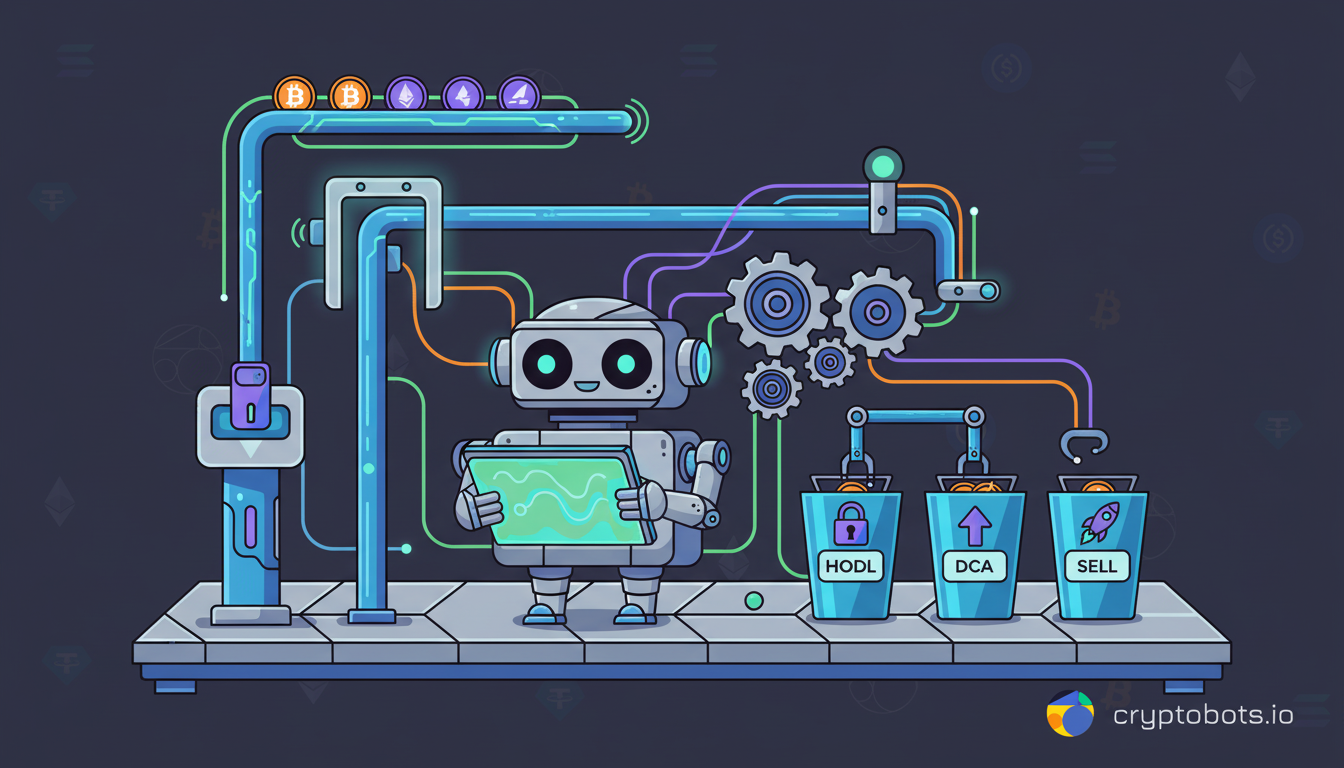
Automated crypto trading uses software to execute orders on digital asset exchanges according to preset rules like moving average cross-overs, volume surges, or price channels. These tools run continuously without manual intervention. Software trading does not eliminate market risk or protect against broad price drops. However, non-custodial setups connect to your exchange through restricted API keys, keeping funds inside your personal exchange account. You can test software setups with zero fixed fees when you get started with zero upfront cost.
How automated crypto trading works in 2026
Automated crypto trading programs send buy and sell instructions to cryptocurrency exchanges based on mathematical parameters. Instead of logging into an exchange to place orders manually, you configure rules around technical indicators, trading volume, or bid-ask spreads. The software monitors real-time market data feeds from exchange order books and triggers trade execution whenever market conditions match your criteria.
Global crypto markets operate around the clock, moving billions of dollars in daily volume across international financial centers. Price shifts occur within milliseconds across multiple time zones. Software execution closes the gap between human physical limits and order book movement, helping traders execute disciplined strategies across volatile markets.
The evolution of trading tools
In the early days of digital assets, Bitcoin traders relied on basic browser forms to submit orders. Traders calculated technical indicators in separate spreadsheets and logged entry points by hand. As market liquidity expanded, exchanges opened Application Programming Interfaces (APIs) to external developers.
APIs gave software direct access to exchange order books, allowing automated systems to process price data and place orders in milliseconds. Today, algorithmic execution accounts for the majority of trading volume across major crypto exchanges, connecting cloud-hosted strategy engines directly to high-frequency liquidity pools.
Manual vs. automated trading
Comparing manual trade execution with automated execution highlights differences in speed, asset coverage, and operational discipline:
| Feature | Manual Trading | Automated Trading |
|---|---|---|
| Operating hours | Limited by human stamina | Continuous order processing |
| Execution speed | Seconds to minutes | Milliseconds |
| Emotion handling | Vulnerable to hesitation and panic | Strictly bound to predefined logic |
| Multi-asset coverage | Difficult across more than 2 or 3 pairs | Simultaneous tracking of dozens of markets |
| Strategy testing | Relies on manual logs or selective memory | Backtested against multi-year price data |
Manual traders frequently struggle to follow their own risk guidelines. A trader might plan to cut a loss if Bitcoin drops below a support level, but hesitates in the moment, hoping for a price rebound. Automated systems execute stop loss orders instantly when price touches the designated target, preventing emotional delay from enlarging losses.
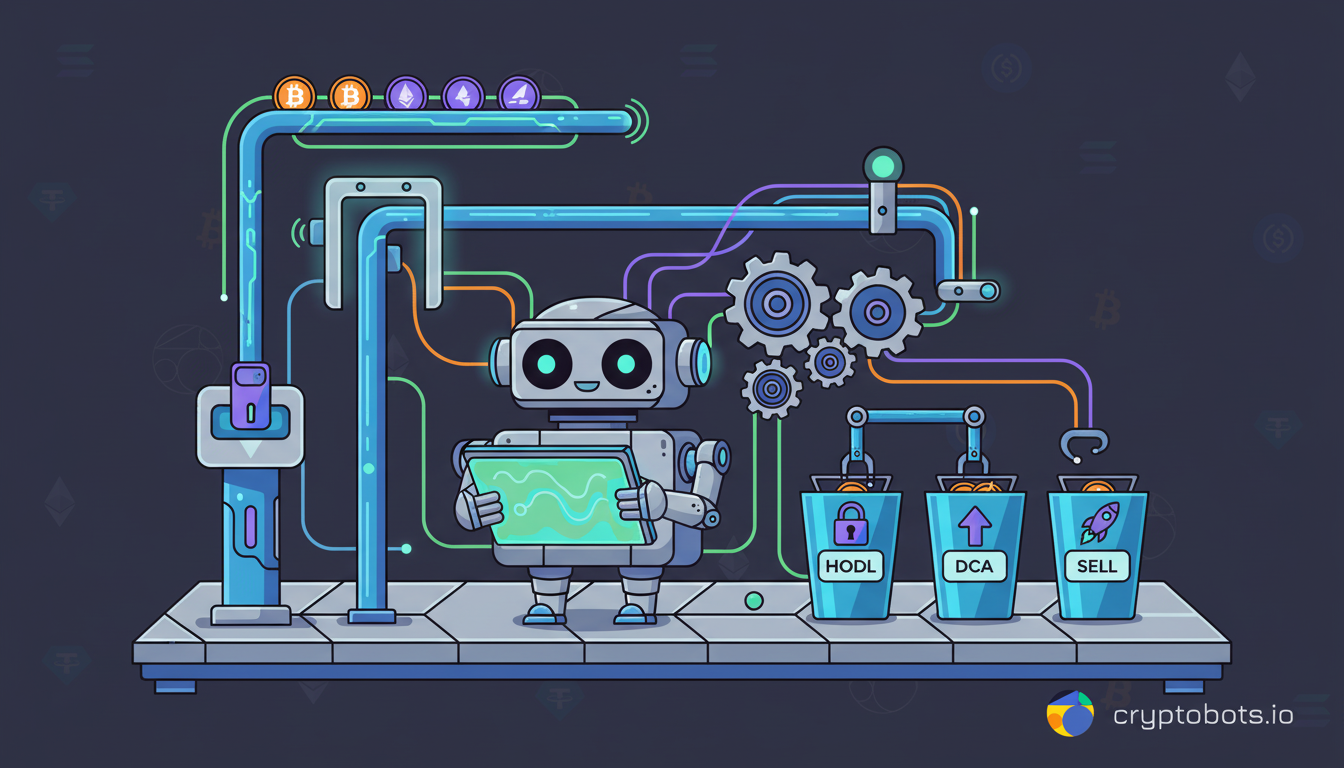 This automated trading dashboard shows live market data and bot activity.
Key benefits of automated trading systems
Using software to run trading strategies brings systematic consistency to portfolio management.
Eliminating emotional discipline breakdowns
Fear and greed represent two of the most consistent causes of trading losses. Rapid market rallies create fear of missing out, driving traders to open long positions near market tops. Sharp selloffs trigger panic, forcing retail traders to exit positions at market bottoms.
Software operates purely on quantitative parameters. It does not experience fear during market downturns or overconfidence during rallies. By adhering strictly to entry, exit, take-profit, and stop-loss criteria, automated strategies maintain clear risk boundaries regardless of market noise.
Continuous market coverage
Liquidity shifts fluidly between regional trading hubs in Asia, Europe, and North America. Significant price breakouts often happen while individual traders are offline or asleep. Automated execution systems maintain constant websocket connections to exchange infrastructure, ensuring that trading setups capture market opportunities at any hour of the day or night.
Systematic execution and historical backtesting
Evaluating whether a trading setup holds a genuine edge requires uniform execution over many trade samples. If a trader skips signals or changes position sizes unpredictably, analyzing strategy performance becomes impossible.
Trading software handles every trade signal with identical logic. Quantitative platforms also let traders test strategy parameters against years of historical market data before committing live capital. Backtesting highlights how a setup would have performed during prolonged bull runs, sharp bear trends, and choppy sideways consolidation. To inspect verified live execution records, review our Proof of Performance page.
Portfolio rebalancing across multiple assets
Managing a diversified crypto portfolio of Bitcoin, Ethereum, and alternative tokens requires ongoing adjustments to maintain target risk allocations. Rebalancing manually across different exchanges takes time and creates execution friction.
Automated systems rebalance allocations systematically. When a single asset rallies sharply and skews your portfolio risk profile, software can take partial profits and reallocate funds into underweighted positions according to your target weighting rules.
Step-by-step framework: from configuration to live trading
Setting up an automated trading workflow requires linking strategy logic to exchange order books through secure protocol connections.
Choosing your core trading strategy
The setup process begins by selecting an execution logic suited to current market conditions and your risk appetite. Popular options include trend-following, mean-reversion, grid trading, and dollar-cost averaging.
Different market environments call for distinct approaches. Range-bound markets suit grid models that trade price swings within fixed boundaries, while trending markets favor momentum setups. On CryptoBots.io, users choose from pre-configured algorithms built for specific token pairs and settlement preferences, including physical spot assets or stablecoin profit targets. You can evaluate available strategy models using the Strategy Explorer.
Connecting exchanges with API keys
Trading software communicates with your exchange account using API keys created inside your exchange security settings on platforms like Binance, Coinbase, or Kraken. An API key set consists of a public key and a secret key that act as secure login credentials.
When generating API keys, you set specific authorization levels:
- Reading access: Allows the software to check account balances, open positions, and live order books.
- Trading access: Allows the software to place and cancel limit or market orders.
- Withdrawal permissions: Keep this permission disabled.
Leaving withdrawal permissions unselected ensures that no third-party system can transfer or withdraw funds out of your personal exchange account.
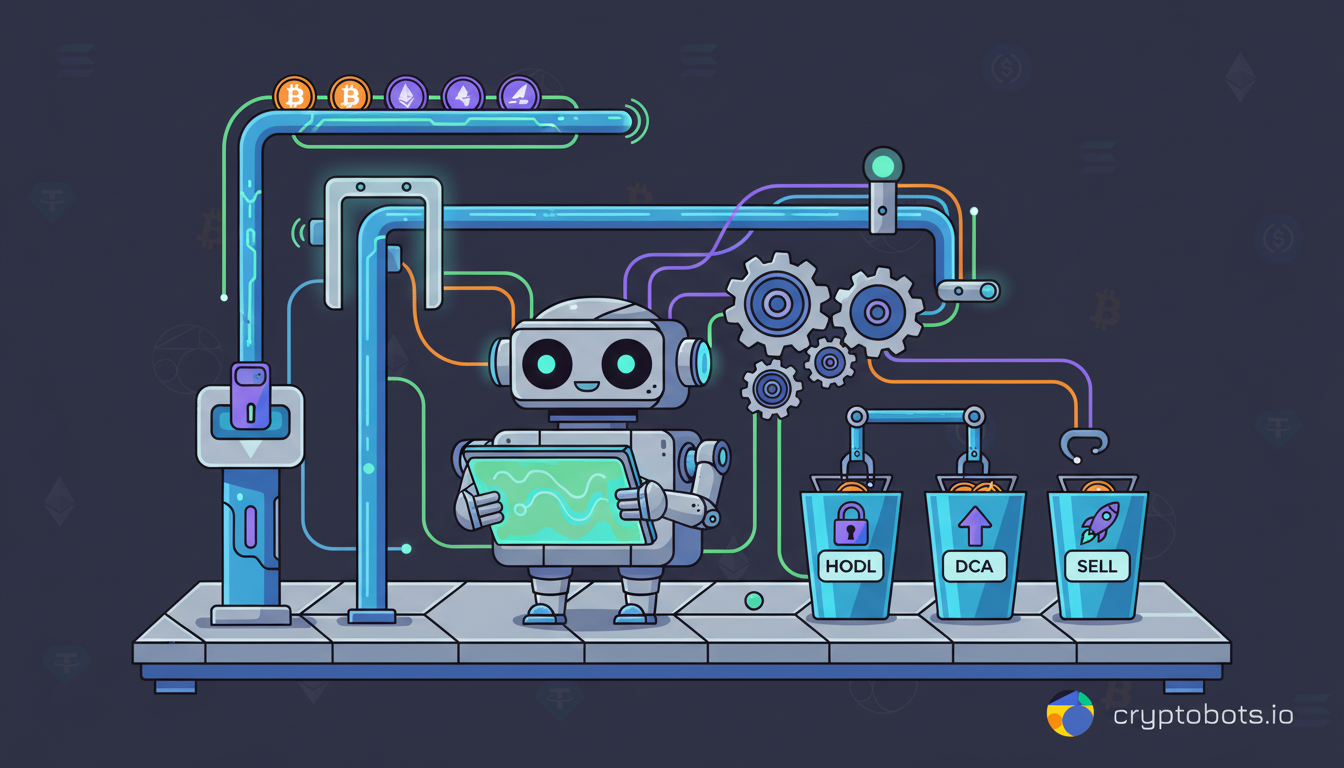 This diagram shows the secure API connection between a user’s exchange account and the CryptoBots.io platform, including how data flows and the security measures in place.
The automated execution engine loop
After establishing connection, the execution engine runs an automated loop across four distinct stages:
- Data ingestion: The engine reads real-time price feeds, order book depth, and trading volume data from the exchange websocket.
- Signal processing: Quantitative rules process technical indicators like moving average convergence divergence (MACD) or relative strength index (RSI).
- Order submission: When price action fulfills the strategy criteria, the engine submits buy or sell orders directly to the exchange API.
- Position tracking: The software monitors open trades continuously, updating trailing stops or closing positions as price targets are hit.
Understanding performance profit sharing
Traditional trading software platforms charge fixed monthly fees, forcing traders to pay software costs regardless of whether their trading account makes money or loses capital.
CryptoBots.io uses a performance-aligned profit-share model with no monthly fees or upfront fees. The platform collects a 33% fee only on net realized trading profits generated by the software, leaving 67% with the trader. If the software does not generate net positive returns, you owe zero platform fees. Read complete terms on our Profit Share page.
Popular automated trading strategies
Selecting the right strategy model depends on structural market conditions, volatility levels, and your settlement preferences.
Contract mechanics: spot, linear, and inverse markets
Understanding contract settlement rules is necessary before launching automated strategies:
Spot trading involves buying and selling actual underlying digital assets directly. Spot strategies carry no leverage liquidation risk, making them suitable for long-term coin accumulation. Examples include strategy CB001 for spot Bitcoin accumulation and CB010B for generating cash yield from spot positions.
Linear derivatives use stablecoins like USDT or USDC for margin collateral and profit settlement. Gains and losses calculate directly in fiat value, simplifying accounting and tax reporting. Strategies like CB003 and CB011B trade market swings using linear futures while settling net gains in stablecoins.
Inverse derivatives use the underlying cryptocurrency itself, such as Bitcoin or Ethereum, as margin collateral. Realized profits pay out in native cryptocurrency rather than stablecoins, appealing to traders who want to increase their total coin count over time. Strategy CB002 uses inverse contracts to accumulate native Bitcoin.
Five core bot algorithms
1. Trend following
Trend-following strategies identify directional market momentum using exponential moving averages, average directional index (ADX) values, and price channel breakouts. When an asset breaks through major resistance with expanding volume, the algorithm opens a long position and holds it until trend momentum weakens.
2. Grid trading
Grid algorithms create a grid of buy and sell limit orders at incremental price intervals above and below the current market price. As the asset price moves within a range, the bot buys at lower grid levels and sells at higher grid levels, locking in small gains from normal market fluctuations.
  Grid Level 3: [SELL ORDER]  $65,000
  Grid Level 2: [SELL ORDER]  $64,000
  ----------------------------------- Current Price: $63,500
  Grid Level 1: [BUY ORDER]   $63,000
  Grid Level 0: [BUY ORDER]   $62,000
3. Dollar-Cost Averaging (DCA)
DCA setups automate recurring purchases over fixed time intervals, buying set monetary amounts daily or weekly regardless of short-term price movements. Spreading entries across full market cycles smooths out average purchase prices and removes the need to time market bottoms.
4. Arbitrage execution
Arbitrage setups monitor price differences for the same token pair across separate exchanges. If Bitcoin trades at $63,000 on Binance and $63,150 on Coinbase, an arbitrage bot buys on the lower-priced exchange and sells on the higher-priced exchange to capture the spread.
5. Market making
Market-making bots place limit orders on both sides of the exchange order book to earn the bid-ask spread. These strategies depend on low-latency connections and precise inventory management to control risk during volatile directional price moves.
Risk management principles for automated trading
While automated trading accelerates order execution, running algorithms without risk controls can accumulate losses just as quickly as gains. Protecting trading capital requires strict position caps, leverage constraints, and loss limits.
Conservative leverage settings
Leverage allows traders to open position sizes larger than their deposited collateral by borrowing funds from the exchange. While leverage magnifies gains during favorable trends, it multiplies drawdowns and introduces liquidation risk.
High leverage levels like 10x or 20x leave almost no room for normal price fluctuations in volatile crypto markets. A 2% adverse price move can trigger total position liquidation. CryptoBots.io enforces strict risk controls by capping maximum leverage at 1.0x for inverse contracts and 1.5x for linear derivatives. Keeping leverage within those limits reduces the risk of leverage liquidation events during market volatility spikes and helps preserve account capital.
Safety nets and stop loss controls
Stop loss orders act as mandatory risk controls. A stop loss sends an immediate exit instruction when an asset hits a designated price, preventing small drawdowns from turning into major capital losses.
In addition to individual stop loss orders, structural allocation rules provide extra account safety. CryptoBots.io applies a 40% safety net allocation. This reserve balance remains completely unencumbered by open trade positions, absorbing market volatility without risking your full account equity.
Portfolio allocation rules
Even effective trading setups face adverse market regimes. Placing all available capital into a single asset or single strategy increases overall drawdown risk.
Sound risk guidelines rely on three main principles:
First, spread trading capital across uncorrelated digital assets rather than concentrating funds in a single token. Second, pair range-bound grid algorithms with trend-following setups so quiet consolidation periods balance out choppy trendless phases. Third, enforce hard cap percentage limits on the amount of capital assigned to any single automated strategy.
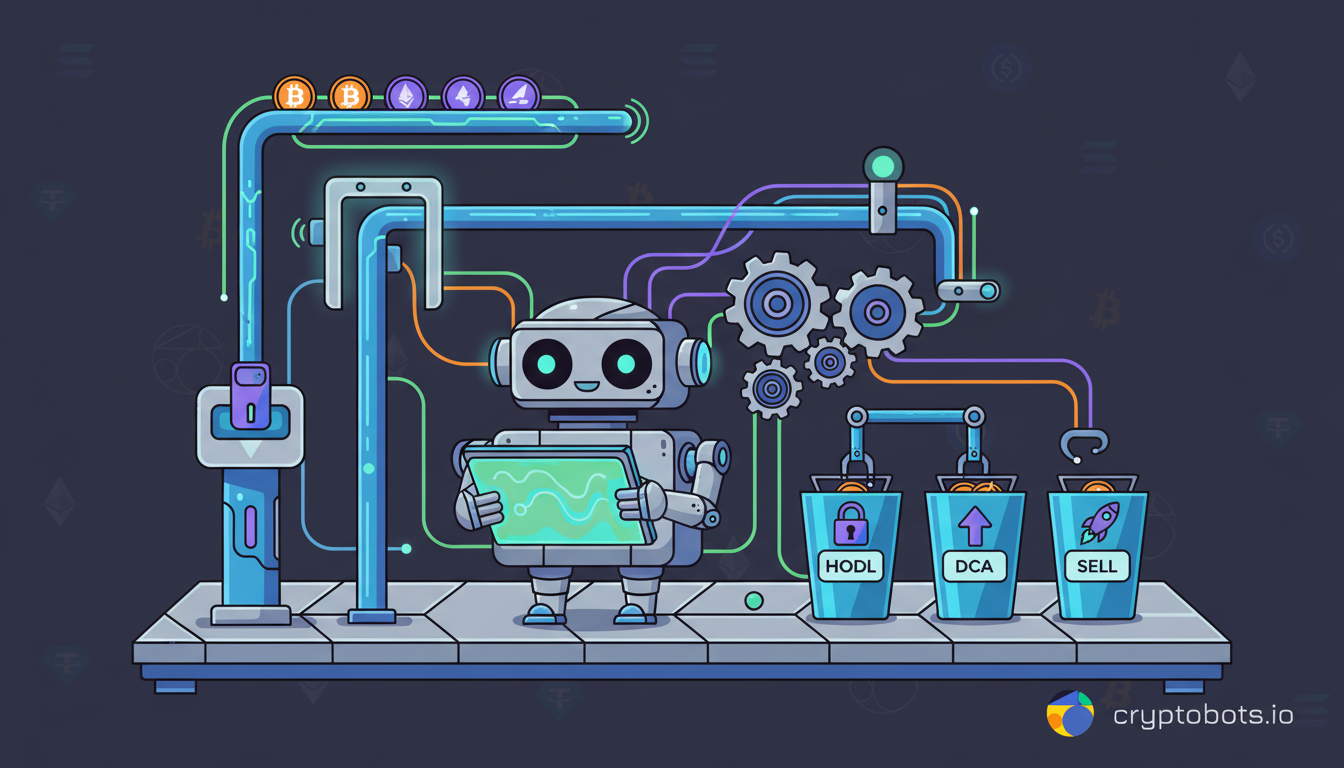 This risk management dashboard shows settings for leverage, safety nets, and other protective measures within an automated trading system.
Evaluating automated trading platforms
Choosing trading software requires evaluating pricing structure, key security practices, and verifiable track records.
Fixed monthly fees represent the traditional model, with vendors charging every month. Under that model, you pay software fees regardless of whether your trading portfolio gains value or suffers losses. In contrast, performance profit-sharing eliminates monthly fee overhead. Under a zero upfront fee model, you pay a share of realized net profits only when the strategy generates positive trading returns.
  Traditional SaaS Bots:      Pay a fixed fee (Profit or Loss)
  CryptoBots.io Model:        Pay $0 upfront -> 33% of Profits Only
Custodial platforms require users to deposit crypto assets directly into company wallets, creating third-party risk and potential withdrawal friction. Non-custodial frameworks use restricted API keys, keeping your capital safe inside your personal account on major exchanges like Binance, Coinbase, or Kraken. You keep full control over your funds and can disconnect API access instantly at any time.
Unverified trading results are widespread across digital asset marketing. Evaluating software requires access to clear transaction records. Reliable platforms maintain public trade logs where performance data can be cross-referenced against historical exchange records. Traders can inspect detailed performance histories inside the CryptoBots Data Room.
International crypto participation continues to grow across major financial hubs, as documented in research on global crypto adoption trends. Modern trading platforms support global users by offering multi-language dashboard interfaces connected to major international exchanges alongside continuous technical support.
Future trends in automated crypto trading
Algorithmic execution continues to adapt as market structure, analytical tools, and regulatory environments evolve.
Early trading bots relied on static technical rules like simple moving average crossovers. While effective during clear trends, static parameters often struggle during sudden regime shifts. Modern systems apply advanced data analytics to process order book imbalances, liquidity depth, and volume profiles in real time. Rather than relying on fixed rules, newer systems dynamically adjust grid intervals and trailing stop levels to match changing volatility.
As financial regulators establish clear operating guidelines for digital assets, automated execution tools are integrating institutional risk practices. Clearer regulations create safer environments for retail traders, reducing counterparty risk and improving liquidity across major exchanges.
Sophisticated execution tools that once required institutional infrastructure are now accessible to retail traders. Cloud execution engines, direct exchange APIs, and performance-based fee structures allow individual investors to run disciplined trading strategies without complex software engineering.
Setup guide: starting your automated workflow
Launching an automated trading system on CryptoBots.io takes four straightforward steps:
- Select an algorithm: Browse the strategy catalog to review setups for BTC, ETH, SOL, or stablecoins, selecting a model that matches your goals and risk tolerance.
- Generate exchange API keys: Log into your exchange account on Binance, Coinbase, or Kraken, create new API keys with reading and trading permissions enabled, and confirm that withdrawal permissions are turned off.
- Link keys to CryptoBots.io: Enter your public key and secret key into your CryptoBots dashboard to establish a secure connection to your exchange account.
- Activate automated trading: Turn on your selected bot. The platform monitors exchange order books continuously and executes trades based on your strategy rules.
Before turning on live trading, confirm that your exchange account holds enough base cryptocurrency or stablecoins to cover the minimum position sizes required by your chosen strategy.
FAQ: automated crypto trading in 2026
Is automated crypto trading secure?
Automated trading is secure when using non-custodial software with restricted API credentials. Because withdrawal permissions remain disabled, your capital stays inside your personal exchange account. Security depends on protecting your exchange credentials and enforcing sensible risk rules, such as maximum leverage caps of 1.0x for inverse contracts and 1.5x for linear derivatives.
How much capital is required to start?
There are no minimum balance requirements under a zero upfront fee model. However, exchanges set minimum trade order sizes, usually between $10 and $20 per order. To allow proper position sizing across multiple order levels, starting with an exchange balance between $200 and $500 is practical for most strategies.
Can trading bots lose money during sudden market drops?
Yes. Automated software follows programmed logic, but operates in volatile financial markets. If underlying asset prices fall, open spot or long derivative positions experience drawdowns. Applying leverage caps of 1.0x for inverse contracts and 1.5x for linear derivatives, stop loss orders, and safety net allocations helps manage downside risk, but no software can eliminate market risk entirely.
How many trades does a bot execute daily?
Trade frequency depends on the specific strategy model and market volatility. Tight grid strategies and high-frequency arbitrage bots may place dozens of small orders daily during active market phases. Trend-following models might execute only two or three trades a week while waiting for confirmed breakout setups.
What sets CryptoBots.io apart from conventional trading bot software?
CryptoBots.io uses a performance profit-share structure with zero monthly fees, collecting a 33% fee only on profitable trades. The platform caps leverage at 1.0x for inverse contracts and 1.5x for linear derivatives, maintains a 40% capital safety buffer, operates through non-custodial API connections, and provides verified historical trade records.
Summary: building a disciplined trading strategy
Automated crypto trading provides a systematic method for participating in digital asset markets round the clock. By removing emotional bias, monitoring exchange order books continuously, and enforcing strict risk guidelines, software helps traders manage capital with operational discipline.
Long-term success depends on sound risk management rather than chasing unrealistic yields. Maintaining conservative leverage, keeping cash safety reserves, and relying on non-custodial API architecture allows traders to build durable market setups across changing market cycles.
CryptoBots.io gives you access to automated trading algorithms without monthly fees. With non-custodial API security, a conservative leverage cap of 1.0x for inverse contracts and 1.5x for linear derivatives, and a performance model where you pay only when your account earns net positive returns, you can run your trading strategy with complete confidence. Take control of your strategy today when you get started with CryptoBots.io.