
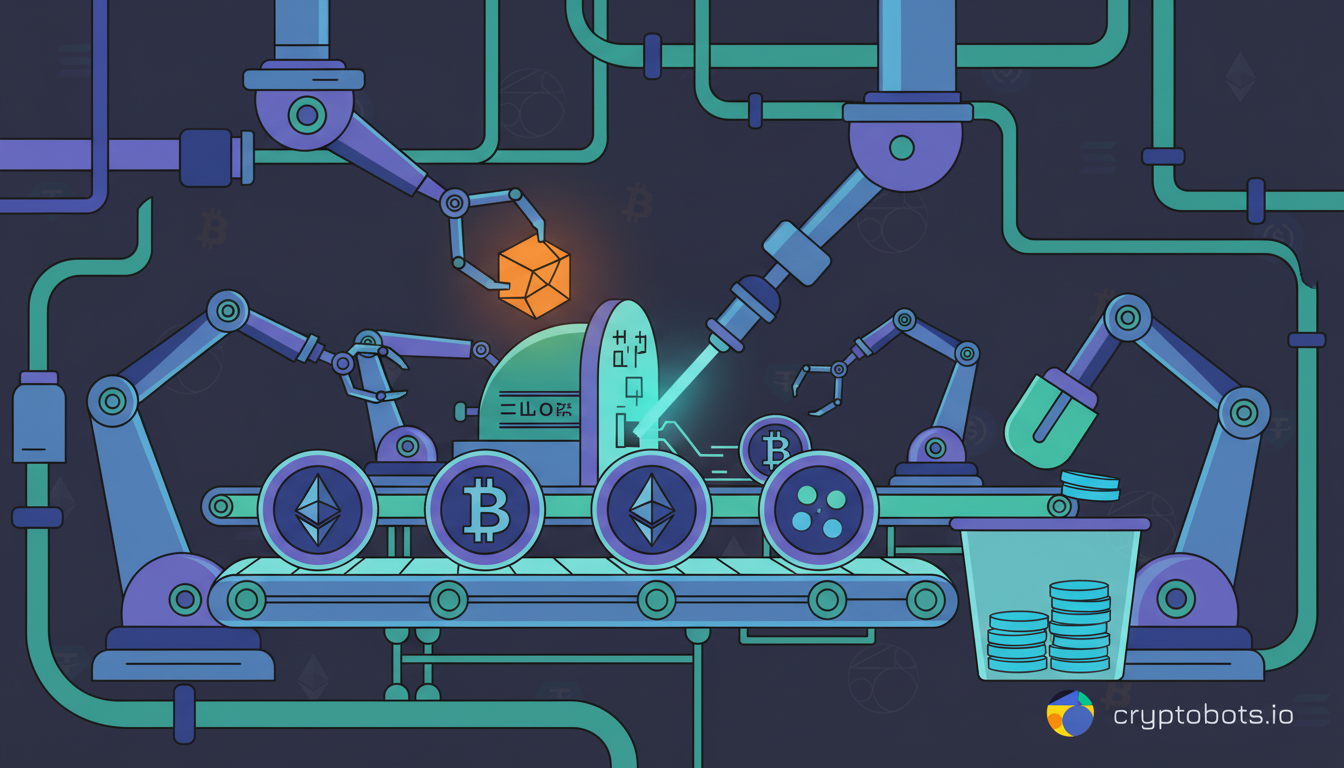
Automated crypto trading uses specialized software to monitor price feeds and execute buy or sell orders automatically according to pre-set mathematical rules. Instead of sitting in front of monitors to place trades manually, you set specific criteria that instruct the system when to enter and exit positions.
While trading software eliminates the need for manual order entry, it does not guarantee profits or erase market volatility. Platforms like CryptoBots.io connect directly to your preferred exchange via secure trading permissions, leaving your funds in your wallet while charging a fee only when trades generate net earnings. You can get started with zero upfront cost to automate your strategies.
Mechanics of automated crypto trading
To understand how automated crypto trading works in practice, it helps to contrast it with traditional manual order placement. A manual trader looks at chart patterns, calculates position sizes, and manually submits orders through an exchange interface. An automated system runs those same evaluation steps through programmed software logic that operates continuously on cloud servers.
When market conditions match your pre-configured parameters, the trading bot generates an order and sends it directly to the exchange. For example, a basic automated rule might track Bitcoin and trigger a purchase whenever its price falls 4% within a six-hour window, followed by an automatic sell order when the price recovers by 6%.
Advanced setup configurations go far beyond single price triggers. They combine relative strength readings, moving average crossovers, order book liquidity depth, and volatility indicators across multiple trading pairs simultaneously. Because digital asset markets never close, software execution gives traders systematic coverage across all time zones.
How bots connect and trade: APIs and order execution
Trading algorithms rely on three interconnected stages to read market data and manage positions: API integration, strategy logic, and order routing.
API integration and secure access
An Application Programming Interface (API) acts as a secure communication pipeline between external software and your cryptocurrency exchange account. To authorize a trading bot, you create a unique set of API keys inside your exchange account settings on platforms like Binance, Bybit, or Coinbase, then save those credentials in your bot control panel.
Exchange API keys carry distinct permission levels:
- Read permissions: allow the software to view your account balance and historical transaction records.
- Trade permissions: allow the software to open, modify, and close orders on your exchange account.
- Withdrawal permissions: allow assets to be moved out of your exchange account to external wallet addresses.
Reputable trading software requires read and trade permissions only. CryptoBots.io operates exclusively on trading access, meaning your capital remains secured inside your personal exchange account where no third party can withdraw it.
Strategy execution and conditional logic
Once connected to your exchange account, the bot continuously compares live ticker data against conditional rules. Every trade follows a structured sequence:
- Trigger: market conditions meet specific pre-set criteria, such as a momentum index dropping into oversold territory.
- Calculation: the bot determines optimal order sizing based on your defined risk parameters and available balance.
- Submission: the system transmits a direct trade request over the exchange API.
- Exit management: pre-configured stop-loss or take-profit orders automatically close the position when target price thresholds are reached.
Because these steps execute automatically, orders fill without the delays or second-guessing that often happen during rapid market shifts.
Market data monitoring and order placement
Trading software ingests real-time order book entries, trade prints, and price candles directly from exchange websockets. When your strategy criteria are met, the bot submits limit or market orders within milliseconds.
Fast order placement helps reduce slippage, which is the difference between the price you expect when setting a trade and the actual execution price. In volatile market environments, automated execution captures pricing opportunities that human traders miss due to reaction lag.
Essential automated trading strategies
Automated platforms execute a wide range of trading approaches tailored to different market cycles and asset profiles.
Trend following and momentum
Trend-following algorithms aim to capture extended price movements. The software buys when technical indicators confirm an established upward trend and sells when momentum weakens or technical support breaks down. These systems perform best during sustained bull or bear markets where directional momentum remains clear over extended periods.
Arbitrage and market making
Arbitrage strategies search for price discrepancies for the same asset across different exchanges or trading pairs. When a price gap appears, the bot buys on the cheaper exchange and sells on the pricier one, capturing the difference. Market-making bots place limit buy orders slightly below current prices and limit sell orders slightly above them, capturing income from the spread between bid and ask prices.
Mean reversion and grid execution
Mean-reversion strategies assume that asset prices eventually return to their historical averages after sudden spikes or drops. The software buys during sharp sell-offs and sells during aggressive price rallies. Grid bots use a similar logic by placing a series of buying and selling orders at regular price intervals above and below current market levels, generating incremental returns as prices fluctuate within a range.
Derivatives and contract management
Many modern setups trade derivative contracts like linear USD-settled futures or inverse crypto-settled contracts. These instruments allow algorithms to go long or short with precision, hedging existing portfolio holdings or generating returns regardless of whether the broader market trends up or down.
Core risk management controls
Automated execution is only as reliable as the risk management settings behind it. Protecting capital requires strict boundaries built directly into the trading software.
Stop-loss and take-profit rules
Automatic stop-loss rules close losing trades at predefined price levels, capping maximum potential losses per position. Take-profit targets automatically lock in earnings when an asset reaches target resistance levels, preventing open profits from evaporating during sudden market reversals.
Position sizing and conservative leverage
Effective risk management caps the percentage of total capital allocated to any single trade. When trading derivative markets, managing leverage settings is equally critical. Using conservative leverage caps, such as 1.0x for inverse contracts and 1.5x for linear derivatives, alongside healthy margin buffers protects accounts from unexpected liquidation events during extreme volatility spikes.
Backtesting and paper trading
Before deploying real funds, experienced traders test strategy logic in safe environment settings:
- Backtesting: runs strategy parameters against historical price data to evaluate hypothetical drawdowns, win rates, and total profitability.
- Paper trading: executes trades in live market conditions using simulated money to verify software logic without financial risk.
Testing reveals structural weaknesses in a strategy before real capital is placed at risk.
Practical advantages of software automation
Using algorithmic software offers concrete operational advantages over manual trade execution.
Continuous execution and timing precision
Cryptocurrency markets trade 24 hours a day, 365 days a year. Major market movements often occur during overnight hours or periods when manual monitoring is impossible. Automated systems maintain continuous tracking, opening and closing positions instantly whenever conditions match your parameters.
Elimination of emotional hesitation
Emotional impulses account for many trading losses. Fear causes investors to panic sell at market bottoms, while greed leads to buying at the peak of unsustainable rallies. Trading algorithms follow coded instructions without panic, fear, or overconfidence, maintaining discipline across all market environments.
Multi-asset portfolio monitoring
A single investor can comfortably analyze only a few trading pairs at once. Automated systems monitor dozens of crypto assets across multiple exchanges simultaneously, adjusting position sizes to keep overall portfolio allocations balanced automatically.
Navigating security and technical risks
While automation provides speed and discipline, users must understand and manage practical operational risks.
Securing API keys and exchange access
Account safety depends on how securely you store and manage API keys. If an unauthorized entity gains access to API keys that have withdrawal rights enabled, your exchange funds could be compromised.
To protect your funds:
- Never enable withdrawal rights on API keys generated for trading software.
- Restrict API access to specific IP addresses belonging to your bot provider.
- Secure all exchange accounts with robust two-factor authentication (2FA).
Platforms like CryptoBots.io operate strictly through non-custodial trade authorizations, ensuring your assets stay in your exchange account under your direct ownership.
Market volatility and strategy decay
No single strategy performs well in every market environment. An algorithm tuned for trending markets can experience repeated small losses during sideways consolidation. Similarly, range-bound strategies can underperform during strong, single-direction breakouts. Periodic review ensures your active bots match current market structures.
System latency and infrastructure health
Automated trading requires reliable internet connectivity, exchange API availability, and cloud server uptime. Server delays or exchange maintenance outages can disrupt order submission. Reputable automation services use redundant server locations and direct exchange connections to minimize technical interruptions.
Selecting a secure automated platform
Choosing an automated platform involves evaluating security architecture, pricing structures, and execution safeguards.
Key features to verify include:
- Custody model: ensure the service uses non-custodial API access without withdrawal privileges.
- Pricing structure: prefer profit-share arrangements over high monthly fees that charge you regardless of performance.
- Performance visibility: select platforms that share clear, verifiable trading results.
- Risk settings: check for flexible stop-loss limits, position boundaries, and conservative leverage options.
- Exchange support: confirm native compatibility with major exchanges like Binance, Bybit, Kraken, or Coinbase.
Why CryptoBots.io uses a performance-first approach
CryptoBots.io aligns platform incentives directly with user outcomes through a transparent structure:
- Zero upfront fee: no monthly fees or setup charges to start trading.
- 33% profit-share pricing: you pay a fee only on net realized gains from closed winning trades.
- Non-custodial security: funds remain safely in your personal exchange wallet at all times.
- Verified records: inspect historical strategy performance on the proof of performance page.
- Flexible strategy selection: deploy automated bots across major assets, including dedicated Bitcoin Bots or stablecoin strategies configured for regular passive income.
Step-by-step setup guide
Setting up an automated trading system involves four simple steps:
- Select a trading strategy: choose a bot strategy based on your target digital asset, risk tolerance, and general market outlook.
- Connect your exchange API: generate API keys in your exchange account with trade permissions enabled, then save those keys in your bot dashboard.
- Activate the software: turn on your chosen bot. The system begins monitoring market feeds and executing trades automatically.
- Settle profit shares: under a profit-share model, fees are calculated only when trades close in net profit.
To create your account and link your exchange, follow the CryptoBots.io getting started guide.
FAQ: how does automated crypto trading work?
How secure is automated crypto trading?
Automated trading is secure as long as you configure API key permissions properly. By enabling trade permissions while strictly disabling withdrawal permissions, the software can execute buy and sell orders but cannot transfer funds out of your account.
Can I lose money using crypto trading bots?
Yes. Automated trading operates in real financial markets where asset prices fluctuate unpredictably. Bot software executes systematic trading rules, but it cannot remove market risk. Using conservative position sizing and strict stop-loss rules helps manage downside risk.
What strategies do crypto trading bots use?
Bots execute diverse approaches, including trend following, arbitrage, grid trading, market making, and mean reversion. Certain platforms also offer derivative strategies that trade linear or inverse contracts to handle different market trends.
Is automated trading suitable for beginners?
Yes. Modern platforms offer pre-configured strategies that allow beginners to automate trading without writing software code or spending hours analyzing complex price charts.
How much does automated crypto trading cost?
Pricing models vary. Many software platforms charge recurring monthly fees regardless of trade performance. In contrast, platforms like CryptoBots.io use a zero-upfront, profit-share model where you pay 33% of net profits only when your trades land in profit.
Final thoughts on trading automation
Understanding how automated crypto trading works lets you use modern market infrastructure safely and efficiently. Trading software delivers continuous execution, fast order placement, and strict rule enforcement, eliminating manual entry delays and emotional mistakes.
While market risks remain present, choosing a non-custodial platform equipped with conservative risk management tools and zero upfront fees gives you an effective way to automate your crypto trading.
To see how automated trading strategies can work for your exchange portfolio, visit CryptoBots.io and start trading today with zero upfront cost.