
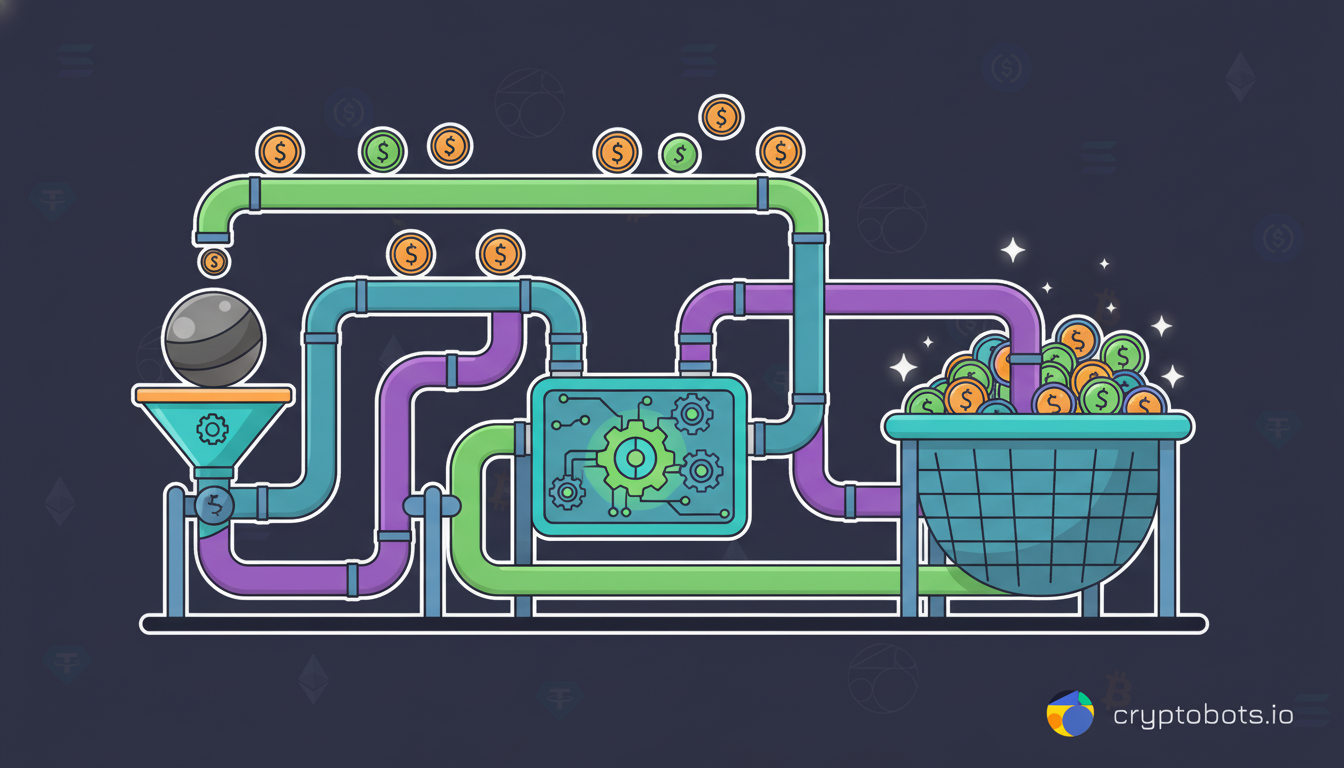
Automated crypto trading can be profitable, but it is not a guaranteed money printer. Overall returns depend heavily on market conditions, strategy design, and risk management. Poor settings during a sudden crash will still lose money. Using API permissions allows trading software to execute strategies directly on your exchange account without taking custody of your funds. You can get started with zero upfront cost on CryptoBots.io and pay only when your trades make money.
Beyond marketing claims, achieving consistent gains requires a clear operational framework. This guide examines how trading algorithms function, which strategies produce gains, how to handle market drawdowns, and how to choose a reliable platform.
How automated trading generates profit
The core question of whether automated systems deliver consistent returns comes down to execution quality and edge. Algorithms execute pre-programmed rules instantly when market conditions match defined criteria. This speed lets trading software capture short-term price movements that human traders miss.
Automated algorithms run continuously without fatigue. They buy and sell according to mathematical conditions rather than fear or greed. When a market drops sharply, manual traders often hesitate or panic sell at the worst time. A trading bot executes its programmed exit or position adjustment without delay.
However, speed cuts both ways. If an algorithm uses flawed logic or bad risk parameters, it will execute bad trades faster than a person would. Profitability is never an inherent property of the software itself. It is the result of applying a proven trading edge with disciplined risk controls across thousands of market movements.
Factors that determine trading bot profitability
Several technical and structural elements dictate whether an automated account grows or shrinks over time.
Market conditions and asset volatility
Digital asset markets move through distinct phases, including strong trends, tight ranges, and high-volatility panics. Trading algorithms usually perform best when market conditions match their underlying logic. Trend-following algorithms excel during sustained price movements, while grid strategies thrive in range-bound markets. During sudden flash crashes, unmanaged volatility can cause unexpected drawdowns unless protected by hard stop-losses and leverage limits.
Strategy design and historical backtesting
An algorithm is only as effective as its rule set. Successful setups combine reliable technical indicators with clear execution conditions. Key components include:
Exact entry and exit signals based on indicators such as RSI, MACD, moving average crossovers, or volume spikes.
Tailored timeframes aligned with the target holding period, ranging from minutes for scalping setups to days for swing trading.
Clear position sizing rules to prevent over-allocating capital to a single setup.
Before deploying real money, strategies should undergo backtesting against historical market data across bull, bear, and sideways regimes. Historical testing reveals structural weaknesses before capital is exposed to risk. CryptoBots.io offers pre-tested strategies configured for different risk preferences with account settlement in BTC or USD.
Capital preservation and risk controls
Managing downside risk matters more than pursuing high theoretical yields. A single unmanaged market drop can wipe out months of small gains. Effective risk parameters include strict limits:
Leverage constraints. Excessive leverage is the leading cause of retail trader liquidations. CryptoBots.io caps leverage at 1.0x for inverse contracts and 1.5x for linear derivatives with a 40% safety margin to cushion positions against abrupt price swings.
Automated stop-loss orders. Setting clear stop-loss triggers exits losing positions before losses compound.
Equity allocation limits. Limiting the percentage of portfolio equity committed to any single position prevents concentrated downside risk.
Exchange fees and order execution
Trading frequency makes transaction costs a critical variable in net profitability. Exchanges charge maker and taker fees on every executed order. High transaction fees can consume gains from small, frequent trades. Using high-liquidity exchanges like Binance, Coinbase, or Kraken helps keep trading fees low and reduces slippage on order execution.
Security architecture and fund custody
Platform architecture directly affects the safety of your principal. Trusting a third party with direct custody of your crypto assets introduces significant counterparty risk. Secure platforms rely on restricted API connections. Under this model, the software receives permission to execute trades on your exchange account, but withdrawal rights remain blocked at the exchange level.
Practical strategies for algorithmic trading
Automated systems can run several established trading strategies with high precision.
Trend following
Trend-following setups use moving averages and momentum indicators to detect market direction. The algorithm enters a long position during established uptrends and exits when momentum breaks. Automated execution stops traders from closing positions too early during minor pullbacks.
Crypto arbitrage
Arbitrage strategies monitor price discrepancies for the same trading pair across different exchanges. When a price gap opens, the system buys on the cheaper exchange and sells on the pricier exchange at the same time. Because these price differences close within seconds, automated execution is required to capture the spread.
Grid trading
Grid bots place a series of laddered buy and sell limit orders at regular price intervals above and below a central reference point. As the asset moves back and forth within a price range, the bot buys at lower grid lines and sells at higher grid lines, turning market consolidation into incremental profits.
Market making
Market-making algorithms place orders on both sides of the order book to capture the bid-ask spread. By providing liquidity to the market, these systems generate small returns across high trading volumes.
Dollar-cost averaging
Dollar-cost averaging (DCA) algorithms automate buying a fixed dollar amount of an asset at scheduled intervals regardless of price. Buying regularly smooths out average entry prices over time, providing a hands-off method for long-term spot accumulation.
You can examine real strategy configurations across Bitcoin, Ethereum, Solana, and stablecoins on the CryptoBots.io Strategy Explorer.
Risk management and portfolio optimization
Protecting capital during difficult market periods is what separates profitable trading accounts from failed ones over the long term.
To minimize technical and operational risks, traders should follow several practical guidelines:
- Start with conservative position sizes. Test any new algorithm with a small capital allocation. Verify live execution performance over several market cycles before increasing position size.
- Review verified performance data. Track real trade metrics continuously instead of relying on theoretical backtests alone. You can review on-chain verified records on the CryptoBots.io Proof of Performance page.
- Combine complementary strategies. Running a grid strategy alongside a trend-following setup helps balance returns across both range-bound and trending markets.
- Reinvest profits systematically. Compounding realized gains allows trading capital to grow without adding fresh capital from outside investments.
Selecting a reliable automated trading platform
Platform selection plays a major role in long-term trading results. A dependable system must provide transparent pricing, secure connections, and aligned financial incentives.
CryptoBots.io feature comparison
Many commercial platforms charge high monthly fees regardless of whether their algorithms make money. This software-as-a-service model forces users into negative returns during quiet or unprofitable market periods.
CryptoBots.io uses a performance-aligned model built on key operational standards:
Zero upfront fees. There are no monthly setup fees, recurring software fixed fees, or hidden base costs.
Non-custodial API architecture. Capital stays inside your exchange wallet. The system trades via restricted API keys without withdrawal access.
Performance-based pricing. CryptoBots.io charges a 33% profit share fee on realized profits only. If the bot does not generate positive returns, you pay nothing.
Strict leverage caps. Capping leverage at 1.0x for inverse contracts and 1.5x for linear derivatives with a 40% safety net protects capital against sudden liquidations during volatile market spikes.
On-chain verification. Trade execution metrics are logged on the blockchain to guarantee verifiable performance history.
If you are exploring automated tools to build recurring cashflows, read our guide on generating passive income through systematic trading setups.
Frequently asked questions
How quickly can automated crypto trading show returns?
Timeframes vary based on market volatility and the selected strategy. While trading systems execute orders around the clock, evaluating account performance over several weeks or months provides a far more accurate view than tracking daily fluctuations.
What are the main risks involved with trading bots?
The main risks are sudden market crashes, technical exchange API outages, and incorrect strategy configurations. Using conservative leverage, setting strict stop-losses, and choosing secure platforms keep these risks manageable.
Do I need substantial capital to start?
No. You can start with modest amounts on most major exchanges. Starting small lets you verify order execution and system performance before allocating larger sums.
How does CryptoBots.io secure user accounts?
The platform connects via API keys restricted strictly to trading functions. Withdrawals are disabled at the exchange level, meaning your assets remain in your personal exchange account at all times.
Can trading bots generate passive income?
Yes. Once configured, an automated bot executes orders based on its pre-set rules without requiring daily manual trades, offering a hands-off approach to systematic crypto allocation.
Final thoughts on crypto bot profitability
So, is automated crypto trading profitable? Yes, provided you apply disciplined strategies, manage downside risks, and avoid over-leveraging your position. Algorithms eliminate emotional trading errors and execute orders with speed, but they still require sound risk parameters to navigate changing market environments.
Choosing a platform that aligns its fees with your success makes a major difference over time. CryptoBots.io offers a zero-upfront model with performance-based pricing and strict capital protection features.
Ready to automate your trading while keeping full custody of your funds? Get started with zero upfront cost on CryptoBots.io today.