
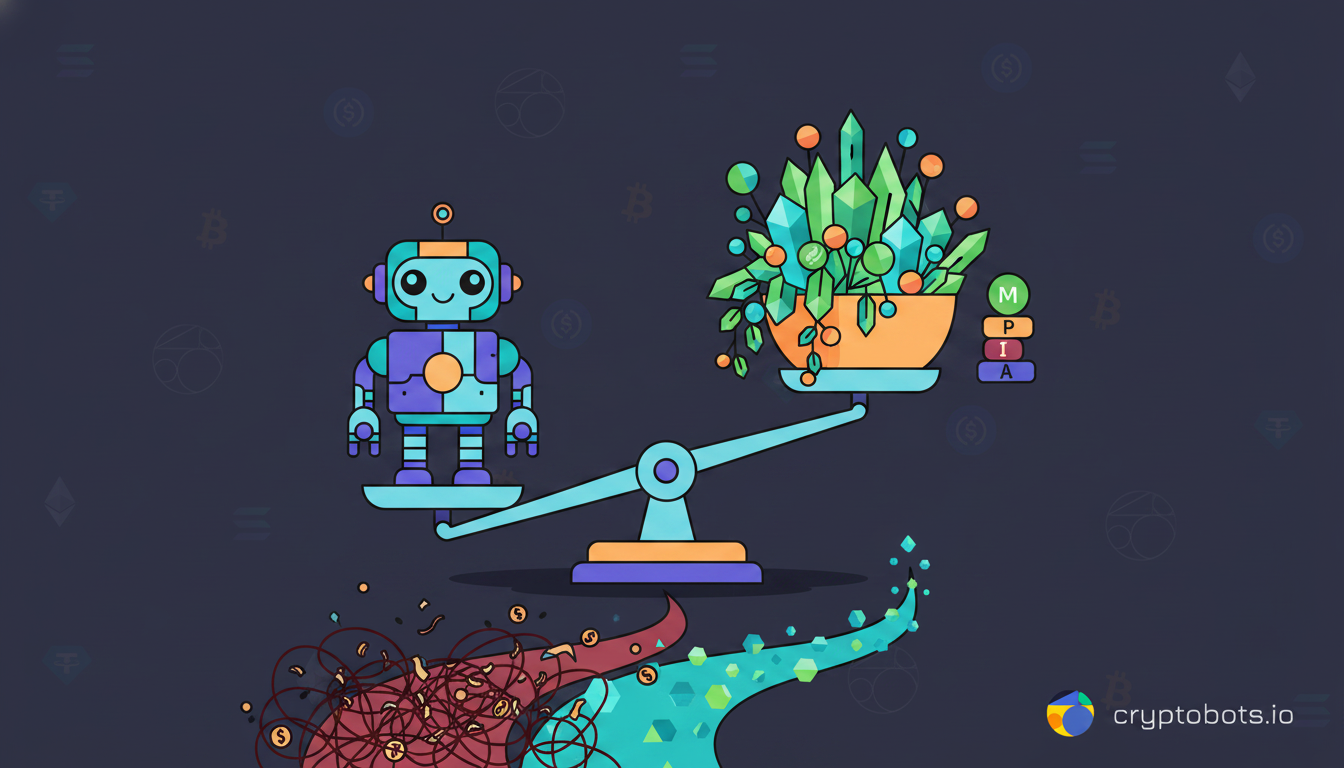
Crypto trading bots are worth using if you need precise order execution and continuous market tracking without spending all day in front of charts. Automated software handles the routine mechanics of trading, but it does not eliminate market risk. Poor strategy parameters or sudden market crashes can still result in financial losses. To make automation worthwhile in practice, you need sensible risk management and low fixed costs. You can get started with zero upfront cost on CryptoBots.io, paying a fee only when your trades record net profits.
Evaluating whether automated software fits your trading goals comes down to pricing models, execution reliability, and how well a platform protects capital during sudden market shifts.
Understanding crypto bots: how automated trading works
A crypto trading bot is software that executes trades automatically based on defined rules. Instead of manually reading price charts, calculating position sizes, and submitting orders on an exchange, you connect an automated system to manage those tasks for you.
The bot communicates with your exchange account through Application Programming Interfaces (APIs). These API keys grant permission to read ticker data and open or close trading positions, but they block withdrawal rights. Your capital remains inside your personal exchange account rather than moving into a third-party wallet.
Automated systems deploy several distinct trading approaches depending on market structure:
Arbitrage strategies capitalize on small price discrepancies for the same asset across different exchanges. Market making places buy and sell orders near the current price to capture the bid-ask spread. Trend following identifies directional momentum and holds positions until technical indicators signal a reversal. Mean reversion relies on the statistical probability that asset prices return to historical averages after sharp swings. Derivatives strategies utilize linear or inverse futures contracts to trade both rising and falling markets.
The core benefits of automated trading
Manual trading presents psychological and practical challenges. Automated systems address structural obstacles that affect human decision-making in fast-moving markets.
Removing emotional impulse
Fear and greed frequently disrupt manual trading discipline. Fear of missing out pushes traders to buy near tops, while panic during sharp pullbacks leads to selling at bottoms. Software executes programmed parameters regardless of market sentiment or social media noise.
Continuous execution and speed
Cryptocurrency markets operate around the clock across global time zones. Opportunities appear at any hour, making constant manual monitoring impossible for an individual. Software runs continuously, scanning technical indicators and placing orders day and night. Furthermore, crypto prices shift in fractions of a second during high volume spikes. Software processes order book changes and completes multi-step trades far faster than any human operator.
Backtesting and scalability
Before risking capital, traders can run a strategy against historical market data. Backtesting demonstrates how a set of rules performed during past bull, bear, and sideways cycles, helping refine entry rules and stop-loss placement. Additionally, tracking ten coin pairs across three exchanges is overwhelming for one person. Automated systems monitor multiple assets simultaneously, applying consistent risk parameters across all connected pairs.
Risks and practical challenges
An honest evaluation requires examining where automated trading can fail. Bots are analytical tools rather than guaranteed income systems, and they carry distinct operational risks.
Market shifts and sudden volatility
Algorithms perform best in the conditions they were built for. A grid bot designed for a sideways market can take heavy drawdowns during a sharp trend breakout. Flash crashes can hit preset stop-loss levels or cause order slippage.
Infrastructure dependencies and data over-fitting
Automated trading relies on stable infrastructure. Server downtime, exchange API delays, or software bugs can cause missed fills or delayed position exits. Another common mistake when setting up bot rules is over-optimization. Tweaking parameters until backtested results look perfect often creates a fragile strategy that fails in live market conditions.
API security and leverage hazards
Restricted API keys cannot withdraw funds, but compromised credentials could allow unauthorized trading activity. Using platforms with strong encryption and restricting API privileges strictly to trading is essential. Furthermore, bots using leverage on derivatives exchanges multiply both gains and losses. Without conservative position sizing, sharp price swings can liquidate positions before the algorithm can recover.
How fixed monthly fees ruin bot profitability
Many traders overlook the impact of fixed monthly software fees. Traditional platforms charge fixed fees regardless of whether your trading strategy makes money. In slow or declining markets, these fixed costs create a persistent drag on your balance.
A profit-sharing model aligns the platform’s incentives directly with your results. When a service charges zero monthly fees and takes a fee only on net profits, you pay nothing during unprofitable stretches. This structural difference determines whether automated trading remains sustainable over full market cycles.
CryptoBots.io: a performance-based approach
CryptoBots.io provides a practical alternative to fixed-fee bot platforms by removing fixed software costs and focusing on strict risk controls.
Key features include:
- Zero setup or monthly fees: You pay no upfront cost, no monthly fees, and no software licenses to begin.
- Aligned profit sharing: The platform retains a 33% share of realized profits only. If the strategy does not generate net gains, you owe nothing. You can review full terms on the Profit Share model page.
- Non-custodial API architecture: Your funds stay in your personal exchange account. Software connects through trading-only API credentials, leaving withdrawal permissions disabled.
- Controlled leverage limits: Strategies use maximum leverage of 1.0x for inverse contracts and 1.5x for linear derivatives, paired with a 40% balance buffer to protect against liquidation during sudden price swings.
- Flexible asset coverage: Options include linear and inverse derivative strategies across major assets, including specialized Bitcoin bots, Ethereum, Solana, and USD-stablecoin pairs.
- On-chain transparency: Trade statistics and cumulative outputs are verified on-chain, providing readable evidence of performance via the Proof of Performance portal.

How to run trading bots safely
To get reliable results from automated systems while protecting your capital, follow these practical habits:
- Start with a test allocation: Allocate a modest portion of your total portfolio when deploying a new strategy to evaluate real market performance.
- Set firm allocation limits: Never invest money you cannot afford to lose in volatile crypto markets.
- Monitor periodically: Let the software handle order execution, but check account dashboards weekly to verify API connectivity and review metrics.
- Avoid mid-strategy interference: Overriding trade entries manually often disrupts the mathematical edge built into strategy rules.
- Keep exchange security tight: Enable two-factor authentication on your exchange account and routinely audit active API keys.

Frequently asked questions
Are crypto trading bots actually profitable?
Crypto trading bots can be profitable when running sound strategies under suitable market conditions. However, returns are never guaranteed. Strategy design, asset selection, and risk management determine long-term results.
What is the biggest risk when using a trading bot?
Unmanaged leverage and sudden market drops represent the largest financial risks. Technical risks include API outages or improperly configured strategy parameters.
How much do crypto trading bots cost?
Traditional platforms charge monthly software fees regardless of performance. Alternative platforms like CryptoBots.io charge zero upfront fees, operating entirely on a 33% profit-share fee deducted only from net gains.
Can beginners set up crypto bots?
Yes. Modern platforms handle complex strategy logic on cloud servers, requiring users only to connect exchange API keys and select asset pairs without writing code.
How do I ensure a bot cannot steal my crypto?
When creating API keys on your exchange, leave the “Withdrawals” option unchecked. This grants the software permission to place orders while blocking any movement of funds off the exchange.
Final verdict: Are crypto bots worth it?
Crypto bots are worth using for traders who want disciplined execution, speed, and continuous market coverage without managing manual orders around the clock. They remove emotional decision-making and carry out strategies with consistency.
However, software is not a shortcut around market risk. Long-term results depend on reasonable leverage, proper risk controls, and fair pricing.
By replacing monthly fees with a profit-share model, non-custodial API security, and verified performance records, platforms like CryptoBots.io offer a sensible way to automate trading while keeping complete control of your capital.
If you want to test automated trading on your exchange account, get started with zero upfront cost on CryptoBots.io today.