
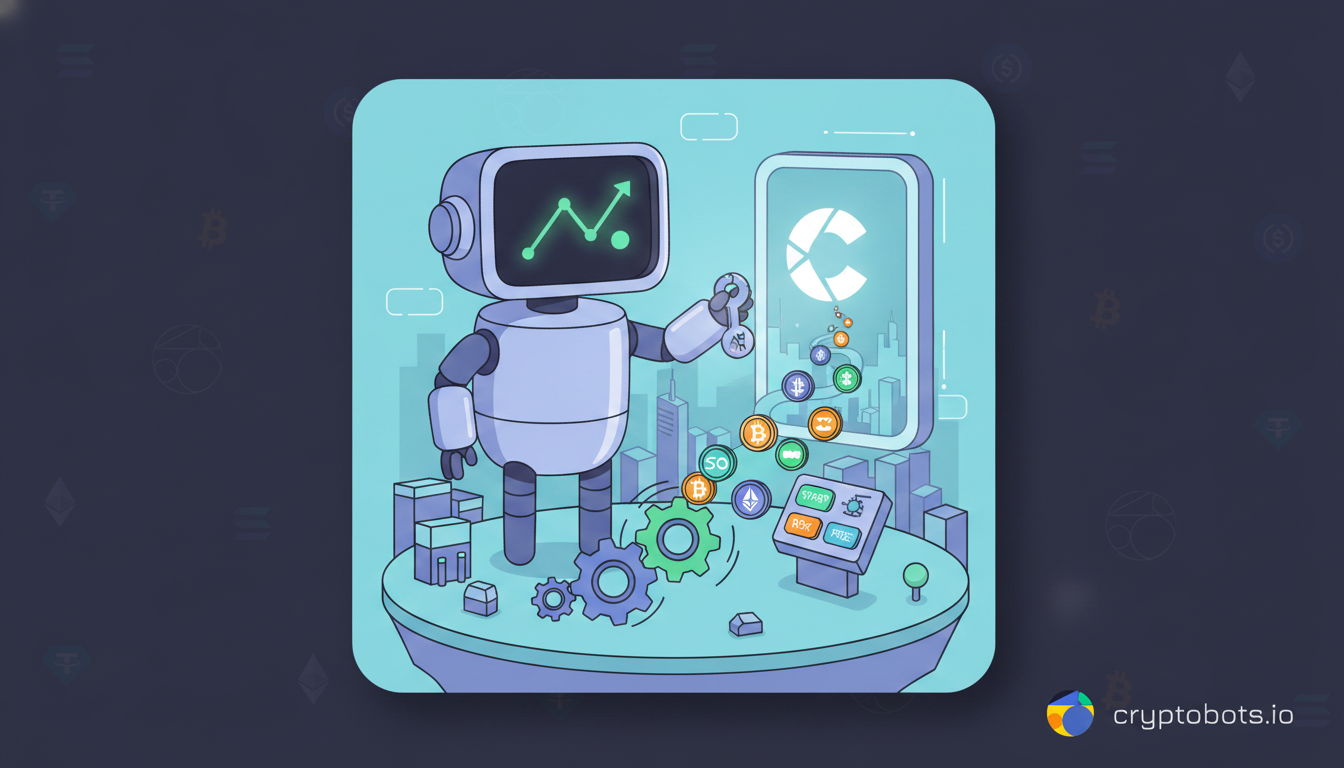
Connecting automated trading software to Coinbase lets you run systematic trading strategies directly from your exchange account. The software places orders on your behalf using trade-only API permissions, meaning your crypto and cash remain in Coinbase custody. Automated trading involves real market risk and cannot guarantee profits, but it eliminates manual order monitoring. If you want to automate your strategies without monthly software fees, you can get started with zero upfront cost on CryptoBots.io and pay only a 33% profit share when trades close in profit.
Coinbase is one of the largest digital asset exchanges in the world. Pairing its deep order books with algorithmic strategy engines gives individual traders execution capabilities comparable to professional trading desks. This complete guide to crypto bots for Coinbase breaks down how API integrations work, how to set up secure trade permissions step by step, which strategies fit Coinbase asset pairs, and how to protect your capital with built-in risk controls.
How crypto bots integrate with Coinbase via API
Automated trading algorithms connect to Coinbase through Application Programming Interfaces (APIs). An API serves as a secure communication channel between Coinbase Advanced Trade order books and an external strategy engine. The engine monitors live market feeds, tracks price movements, evaluates technical indicators, and sends order instructions to Coinbase in real time.
Security depends on how you configure your API keys. Coinbase lets you set exact permissions for every API key you create. A safe trading setup grants Read permissions to monitor portfolio balances and open orders, along with Trade permissions to place market or limit orders. Withdrawal and Transfer permissions must stay disabled. This permission boundary allows an external strategy to execute trades while preventing any system from moving funds out of your account.
Because your capital never leaves Coinbase, you maintain full custody of your digital assets. If you ever want to pause or stop automated execution, revoking the API key inside your Coinbase security dashboard cuts off trading access immediately. For technical specifications on API endpoints and key generation, review the Coinbase Advanced Trade API documentation.
Understanding this API layer clarifies why external trading software does not need custody of your money. The strategy engine simply evaluates price action and sends cryptographic order instructions to Coinbase, where trade execution takes place inside your account.
Step-by-step guide to connecting a bot to Coinbase
Connecting an automated strategy to Coinbase takes only a few minutes and requires no coding knowledge. Generating trade-only API keys and linking them to your strategy engine ensures reliable execution while protecting your account balance.
Step 1: Navigate to developer API settings
Log in to your Coinbase account in a desktop browser. Access your account settings and select the API or Developer Portal tab. Ensure your account has completed identity verification and enabled two-factor authentication, as Coinbase restricts API key creation on unverified accounts.
Step 2: Create a new dedicated API key
Click the button to create a new API key. Name the key with a clear label, such as the strategy engine or platform you intend to connect. When selecting permissions, check View (or Read) and Trade. Leave all Transfer, Withdrawal, and administrative checkboxes completely unchecked.
Step 3: Save your key and secret phrase
Coinbase will display an API Key string alongside an API Secret string. The Secret string appears only once. Copy both strings into a secure password manager immediately. If you lose the Secret string, you will need to delete the API key and create a new pair.
Step 4: Link your API keys on CryptoBots.io
Log in to your account on CryptoBots.io and navigate to the exchange connection screen. Select Coinbase from the list of supported exchanges, then paste your API Key and API Secret string into the encrypted fields to establish the link.
Step 5: Select your strategy and activate
Browse the available trading algorithms in the Strategy Explorer. Match your strategy selection to your preferred asset class, such as Bitcoin, Ethereum, or USD stablecoins. Confirm your position allocation settings and activate the strategy. The algorithm will begin monitoring price action and submitting trades based on its programmed conditions.
+-------------------------------------------------------------------+
|                        Coinbase Exchange                          |
|  +-------------------------------------------------------------+  |
|  | User Capital & Asset Custody (Funds Never Leave Exchange)   |  |
|  +-------------------------------------------------------------+  |
|                               ^                                   |
|               API Connection  | Read & Trade Permissions Only     |
|               (No Withdrawal) | (Encrypted Transport Layer)       |
|                               v                                   |
|                   CryptoBots.io Engine                            |
|  +-------------------------------------------------------------+  |
|  | Strategy Execution | Volatility Models | Risk Buffers (40%) |  |
|  +-------------------------------------------------------------+  |
+-------------------------------------------------------------------+
Recommended bot strategies for Coinbase markets
Choosing an effective strategy depends on current market conditions, asset liquidity, and your personal risk tolerance. Coinbase offers deep liquidity across major base pairs, making it a strong environment for trend tracking, swing trading, and range rebalancing strategies.
Bitcoin trend and volatility models
High trading volume on Coinbase Bitcoin pairs results in low order slippage, which benefits momentum and volatility breakout algorithms. These strategies aim to capture major upward or downward price movements while avoiding choppy, sideways consolidation periods.
Rather than holding assets passively through long market pullbacks, automated trend models monitor moving average crosses, relative strength levels, and volume channels. When momentum triggers confirm a trend, the algorithm opens long positions. When momentum fades or breaks support, the model exits to cash or stablecoins to preserve gains. You can explore specialized models for BTC order books on the Bitcoin Bots page.
Ethereum accumulation and swing trading strategies
Ethereum experiences higher price volatility than Bitcoin, creating regular opportunities for short- to medium-term swing trading. Swing trading algorithms aim to profit from cyclical price movements over several days or weeks.
These bots use mean-reversion metrics to identify overbought or oversold price conditions. When Ethereum price action stretches beyond historical statistical ranges, the strategy opens positions in anticipation of a return to average levels. To review structured automation tailored for ETH pairs, visit the Ethereum Bots section.
Stablecoin preservation and range trading
For traders looking to minimize portfolio volatility, range-trading models on USD stablecoin pairs offer systematic execution within horizontal price channels. These algorithms place buy orders near established support boundaries and sell orders near resistance levels, accumulating small price differentials over time.
Because stablecoin strategies avoid broad directional exposure, they help preserve base capital during bear markets or prolonged consolidation periods. Exploring conservative options on the Stablecoin Bots hub shows how risk-managed automation protects capital during broader market drawdowns.
| Strategy Type | Target Assets | Primary Objective | Volatility Tolerance |
|---|---|---|---|
| Trend Following | BTC, ETH | Capture multi-week directional trends | Moderate to High |
| Mean Reversion | ETH, SOL, Major Alts | Trade swings within defined channels | High |
| Range Grid / Yield | Stablecoins, BTC/USD | Extract gains from horizontal consolidation | Low to Moderate |
Managing risk and security when bot trading on Coinbase
While automation eliminates manual execution delay, software trading introduces specific technical and market risks. Protecting your balance requires combining safe API security practices with conservative risk parameters inside the algorithm.
Regulatory agencies like the U.S. Commodity Futures Trading Commission emphasize the importance of robust risk management and leverage limits in automated digital asset trading. You can review official public safety guidance on the CFTC Regulatory Resources site.
API key security and restrictive access
The primary rule of API integration is minimal permission access. Never create an API key with withdrawal, transfer, or administrative permissions enabled. If a third-party platform asks for withdrawal access, stop setup immediately.
Store your API secret keys in encrypted credential vaults rather than plain text documents or unencrypted files. If you ever suspect a key has been compromised, revoke it immediately inside your Coinbase settings. Generating fresh API keys periodically provides an additional defense against potential credential leaks.
Position sizing and safety net buffers
Excessive leverage is the single largest cause of capital loss in automated crypto trading. Over-leveraged algorithms can trigger account liquidations during brief, sharp price spikes.
CryptoBots.io manages this risk by limiting leverage to a conservative maximum of 1.0x for inverse contracts and 1.5x for linear derivatives while maintaining an automated 40% safety net buffer. This structural safeguard ensures positions can absorb sudden market swings without exposing your account to liquidation risks.
Real-time performance tracking and auditability
Evaluating execution quality requires transparent performance data rather than unverified backtest figures. Reliable automated trading services publish verifiable order execution records so users can review strategy behavior under live market conditions.
Traders can inspect blockchain-verified trade records and historical performance metrics on the Proof of Performance page. Independent execution records give account holders complete visibility into how algorithms perform across different market cycles.
Fixed-fee bots vs. performance share models
The fee structure you choose for automated trading software directly impacts your net returns. The automated software market generally divides into two main pricing models: fixed monthly fees and performance-based profit sharing.
The problem with flat monthly fees
Traditional trading bot marketplaces usually charge fixed monthly software fees. You pay these recurring fixed charges regardless of whether the strategy produced gains, suffered losses, or remained in cash.
During bear markets or low-volatility periods, fixed recurring fees steadily reduce your portfolio balance. Under the CryptoBots.io profit-share model, the fee follows your results instead: if a $2,000 account realizes $200 in net profit during a period, the 33% share is $66 and you keep $134, and if it realizes no net profit, the fee is $0.
The profit-share advantage
A performance-based pricing model links software cost directly to user trading performance. Under this framework, you pay zero setup fees, zero recurring monthly charges, and zero maintenance costs.
Instead, the platform earns a 33% share of realized net profits generated by the algorithm. If a trade closes at a loss or the bot remains inactive during uncertain market conditions, you pay nothing. The service earns income only when your Coinbase portfolio grows. You can examine how this incentive structure operates on the Profit Share page.
+-------------------------------------------------------------------+
|                Fixed-Fee Model vs. Profit-Share                   |
|                                                                   |
|   FIXED-FEE MODEL:                                                |
|   [ Recurring fixed fee ] ---> Paid regardless of profit/loss      |
|   - Flat cost drains portfolio during market drawdowns             |
|                                                                   |
|   PROFIT-SHARE MODEL:                                             |
|   [ Setup Cost: $0 ] ------> [ Monthly Cost: $0 ]                 |
|   - Fee: 33% of REALIZED PROFITS ONLY                             |
|   - Zero profits = Zero platform fees                             |
+-------------------------------------------------------------------+
Frequently asked questions
Can crypto bots withdraw money from my Coinbase account?
No. Coinbase API keys enforce strict permission boundaries. As long as you leave withdrawal and transfer permissions unchecked during key setup, the connected software can only place buy and sell orders. It has no technical ability to move funds or transfer assets out of your account.
Are crypto trading bots legal to use on Coinbase?
Yes. Automated algorithmic trading is legal and explicitly supported by Coinbase. Coinbase provides public API infrastructure specifically to enable third-party trading integrations, custom scripts, and algorithmic software connections.
What happens if Coinbase experiences exchange downtime?
If Coinbase undergoes maintenance or experiences an unexpected outage, API order requests sent during that window return standard error codes. Modern trading platforms include automated error handling that detects exchange outages, pauses trade requests, and resumes order status checks once API endpoints become responsive again.
How much capital do I need to start automated trading on Coinbase?
Coinbase maintains low minimum trade sizes on most base pairs, often starting at just a few dollars. However, to allow trading algorithms to execute proper position sizing and risk management rules, starting with a balance of at least $100 to $500 is recommended.
Streamline your Coinbase strategy with smart automation
Automating your Coinbase trading eliminates manual execution stress, maintains consistent risk discipline, and executes strategies cleanly around the clock. By using trade-only API keys, your capital stays inside your Coinbase account while algorithms manage order timing and position sizing.
You do not need to pay upfront fixed fees to start trading automatically. Visit CryptoBots.io today to browse proven trading algorithms and get started with zero upfront cost.