
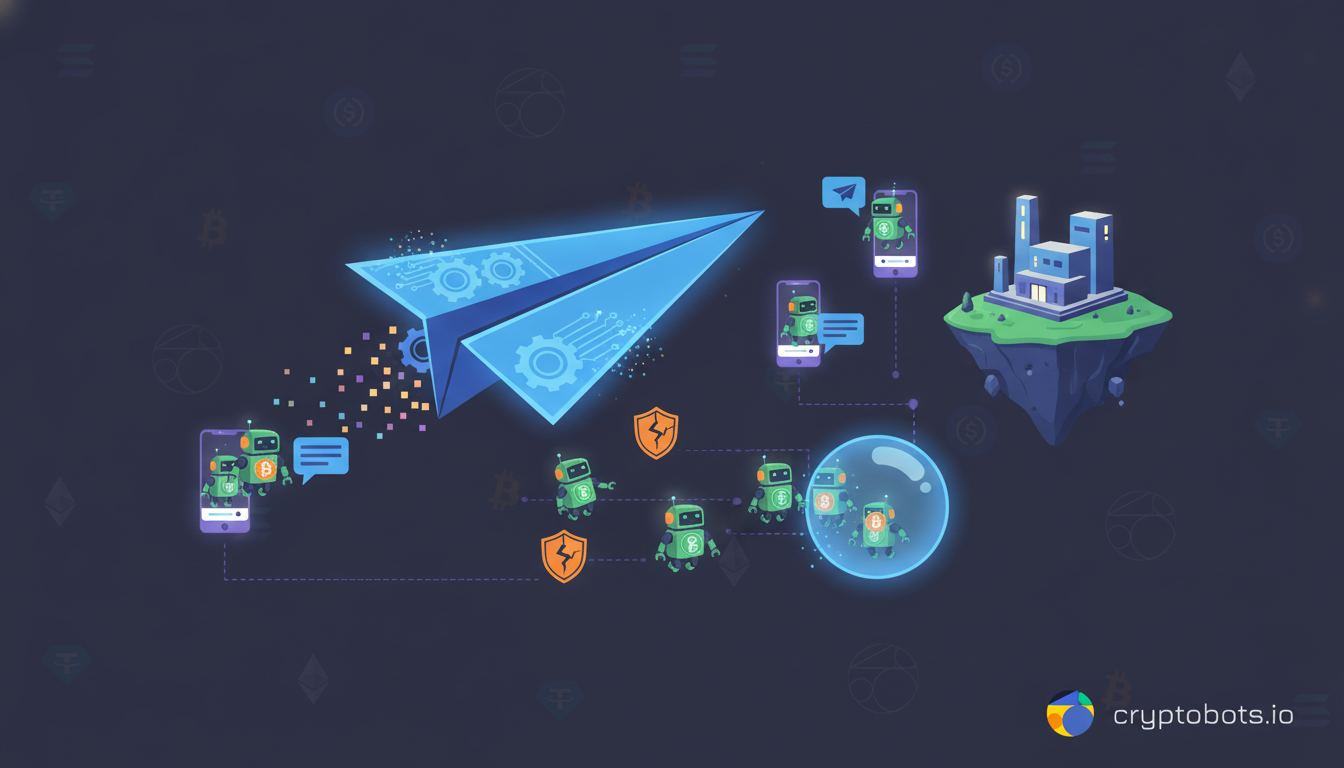
Telegram trading bots execute buy and sell orders directly inside chat windows by sending automated commands to decentralized or centralized liquidity pools. While these tools make fast token purchases convenient on mobile devices, chat-based trading carries real market risk. High price volatility can lead to quick losses, and messaging bots force you to trust remote servers with your private keys while charging transaction fees on every trade. For traders who want disciplined execution on established crypto assets without giving up custody, you can get started with zero upfront cost using non-custodial API automation that keeps your funds inside your exchange account.
What are Telegram crypto trading bots?
Telegram crypto trading bots are automated software programs configured to run within Telegram chat windows. Instead of opening a web browser or connecting to a desktop exchange interface, traders interact with a bot by typing text commands, clicking interactive buttons, or pasting token contract addresses directly into a conversation.
When you paste a token smart contract address into a Telegram bot, the program instantly routes your order to decentralized liquidity pools on networks like Ethereum, Solana, or BNB Chain. This chat-driven process removes the need to manually approve web3 wallet connections or calculate network gas limits during fast-moving token launches.
To process transactions automatically, messaging bots rely on one of two structural setups:
- In-app wallet generation: The bot creates a brand-new web3 wallet inside the chat interface, requiring you to transfer cryptocurrency into that address before executing trades.
- Private key import: You enter an existing wallet’s seed phrase or private key directly into the Telegram chat, granting the software permission to sign transactions on your behalf.
While these setups simplify rapid token swaps on mobile screens, they expose your capital to cloud database leaks, malicious bot clones, and server-side exploits.
Popular categories of Telegram trading bots
When evaluating the best Telegram trading tools, traders usually look at three main operational models: DEX snipers, copy trading tools, and multi-chain routers. Each category serves a distinct trading style, but all share similar underlying key custody and fee structures.
DEX sniping bots
DEX snipers like Banana Gun and Maestro specialize in purchasing newly deployed tokens the exact second liquidity gets added on a decentralized exchange. Traders rely on them to enter low-cap altcoins or newly launched memecoins faster than humanly possible through a standard web browser interface.
The main appeal of sniping bots is execution speed and automated sell triggers designed to exit positions before liquidity gets pulled. However, the downside lies in high default slippage settings. To guarantee rapid inclusion in a block, these bots often subject users to severe price impact and miner-extractable value (MEV) sandwich attacks, where front-running bots drain profit margins before your trade even settles.
Copy trading Telegram bots
Copy trading tools, including platforms like Unibot, monitor specific target wallet addresses on public blockchains like Ethereum, Solana, and Arbitrum. Whenever the monitored wallet executes a buy or sell order, the Telegram bot automatically replicates that exact transaction for its users.
Mirroring profitable traders sounds straightforward, but latency remains a persistent obstacle. By the time a bot detects an on-chain transaction and submits a duplicate order, the original trader has already moved the market price. As a result, copy traders frequently get worse entry prices, eating away at net returns over time.
Multi-chain trading routers
Multi-chain bots like Trojan and Sol Trading Bot allow users to manage orders across several blockchain networks within a single Telegram channel.
These aggregators simplify cross-chain management on mobile devices, but convenience comes with high recurring costs. Multi-chain routers typically levy a 1% fee on every swap on top of standard network gas charges. For active traders, these transactional overhead costs compound quickly regardless of overall account performance.
Hidden security risks of trading inside Telegram
Operating an automated crypto strategy inside a messaging application presents systemic vulnerabilities that go far beyond standard market volatility.
+--------------------------------------------------------------------------+
|                       TELEGRAM BOT SECURITY RISKS                        |
+--------------------------------------------------------------------------+
|  [ Private Key Storage ] --> Keys saved on remote cloud servers          |
|  [ Fixed Transaction Fees] --> 1% fee charged on wins AND losses         |
|  [ Interface Hijacking ] --> Fake bot impersonators in Telegram search   |
|  [ Execution Slippage ]  --> Vulnerable to MEV front-running & sandwich  |
+--------------------------------------------------------------------------+
Server-side private key storage
To execute orders instantly without asking you to sign every transaction through a hardware wallet, Telegram bots store unencrypted or reversibly encrypted private keys on remote cloud servers. If the platform experiences a database breach, server leak, or rogue internal exploit, attackers can drain every connected wallet in seconds. Security organizations frequently warn against storing sensitive cryptographic credentials in cloud database environments, as outlined in standard OWASP application security guidelines.
Impersonation and search hijacking
Telegram’s open search functionality is heavily targeted by scammers. Attackers create duplicate channels and bots that copy the exact branding, usernames, and command menus of established trading platforms. Users who accidentally paste private keys or transfer funds into a fraudulent bot handle lose their assets instantly with zero recourse.
Transaction fees on losing trades
Most Telegram bots charge a flat 1% to 2% tax on every transaction processed through the chat interface. These fees apply equally whether a trade yields a return or ends in a loss. A trader making twenty transactions a week surrenders a significant portion of their trading capital strictly to operational tolls, creating a major obstacle for long-term account growth.
A sustainable automation framework aligns platform compensation with user success rather than penalizing capital on unprofitable setups. You can review transparent trading metrics on our proof of performance page to see how non-custodial systems handle execution without levying per-trade taxes.
Clunky position and risk management
Chat interfaces are ill-suited for fast-moving risk management. Adjusting position sizes, modifying stop losses, or setting trailing profit targets via text commands during volatile market swings often leads to input errors or delayed execution.
Telegram bots vs. API-only automated trading platforms
Comparing chat-based trading applications to non-custodial exchange automation highlights fundamental differences in key custody, pricing models, and capital security.
| Feature | Telegram Trading Bots | Dedicated API Automation (CryptoBots.io) |
|---|---|---|
| Fund Location | In-app hot wallet / Imported private key | Your personal exchange account |
| Key Permissions | Full spending & transfer permissions | Read & Trade API permissions only (No withdrawals) |
| Fee Structure | 1% to 2% per swap (Win or Loss) | Zero upfront; 33% of realized profits only |
| Supported Assets | Unvetted DEX tokens & memecoins | BTC, ETH, SOL, and Stablecoin pairs |
| Risk Parameters | Basic manual stop-loss settings | Capped 1.0x for inverse contracts and 1.5x for linear derivatives with built-in safety net |
| Upfront Costs | Deposit required to hot wallet | $0 setup fees, no monthly fees |
When connecting through API keys on Tier-1 exchanges like Binance, Coinbase, or Kraken, your capital stays under the exchange’s institutional security infrastructure rather than sitting in a messaging app hot wallet.
Why API-only execution protects your capital
The cornerstone of crypto risk management is maintaining exclusive authority over withdrawal rights. Direct exchange API integration establishes a secure perimeter for automated strategies while keeping your funds strictly in your control.
+--------------------------------------------------------------------------+
|                     API-ONLY NON-CUSTODIAL AUTOMATION                     |
+--------------------------------------------------------------------------+
|  [ Your Exchange Account ] <--- Encrypted API Key ---> [ Trading Engine ]|
|   (Binance / Coinbase)                                   (Trade Only)    |
|            |                                                  |          |
|    Funds NEVER Leave                                   NO Withdrawal     |
|      Your Account                                       Permissions      |
+--------------------------------------------------------------------------+
Complete withdrawal protection
When generating an API key inside your personal exchange account, you control the access toggles. You grant read and trade permissions to the trading engine while keeping withdrawal privileges strictly disabled.
Even in the hypothetical event of an external server breach, unauthorized actors cannot transfer funds out of your account. Your capital remains protected by your exchange’s two-factor authentication, hardware security keys, and withdrawal whitelists.
Performance-aligned profit sharing
Rather than deducting fixed swap fees that drain account balances during choppy market phases, CryptoBots.io relies on a performance-based pricing model. There are no setup fees and no monthly fees to pay.
A 33% profit-share fee applies only to net realized gains. If the automated strategy does not generate profits over a trading period, you owe nothing. You can learn more about how this structure operates on our profit share overview.
Algorithmic risk discipline
High-frequency chat trading often degrades into emotional decision-making and revenge trading. Non-custodial automation enforces strict rule-based execution to protect capital across changing market cycles.
Systems run conservative risk models capped at 1.0x for inverse contracts and 1.5x for linear derivatives, backed by automated safety controls. Whether you deploy Bitcoin trading bots or stablecoin yield strategies, trades execute within preset risk parameters around the clock.
How to set up safe exchange automation in 4 steps
Transitioning from risky chat wallets to non-custodial exchange automation takes only a few minutes. Connecting your exchange account involves four basic steps:
First, select an automated strategy tailored to your investment goals, ranging from BTC and ETH accumulation to dollar-pegged stablecoin strategies. Next, log in to your exchange account, navigate to API management, and create a new key pair. Enable spot and futures trading while ensuring the withdrawal permission checkbox remains turned off.
After generating your key pair, input your API key and secret key into your secure platform dashboard. The system verifies connection permissions without taking custody of your assets. Once connected, the trading engine monitors market conditions and executes trades automatically based on your strategy settings. You can track live performance and pause trading at any time.
Choosing the right trading setup for your goals
Deciding between a Telegram trading bot and non-custodial API automation comes down to your risk tolerance, account size, and target crypto assets.
Telegram bots fit traders who deal with small amounts of disposable capital in newly launched memecoins, need sub-second entries into DEX liquidity pools, and accept the technical risks of cloud-stored private keys.
Non-custodial API automation fits investors who want to build balances in established assets like Bitcoin, Ethereum, and Solana without granting withdrawal access to third-party software. It is ideal for those who prefer paying fees only on net profits while maintaining disciplined risk controls.
FAQ: Crypto bots Telegram and automated trading
Are Telegram crypto trading bots safe to use?
Telegram trading bots carry elevated security risks because they require users to generate hot wallets inside the app or import private keys onto cloud servers. If the platform suffers a server breach or database exposure, those private keys can be compromised. Non-custodial platforms connecting via API keys with withdrawal rights disabled offer significantly greater security.
How much do Telegram trading bots charge in fees?
Most popular Telegram trading bots charge a 1% to 2% fee on every transaction processed through the chat interface, regardless of whether the trade is profitable. By comparison, non-custodial platforms like CryptoBots.io charge $0 in setup or fixed fees and take only a 33% share of realized net profits.
Can a Telegram bot withdraw funds from my wallet?
If you generate a wallet inside Telegram or import an existing private key, the bot holds full control over that address. If the software or cloud database is breached, unauthorized transfers can occur. Conversely, API keys configured without withdrawal permissions give external platforms zero ability to move funds out of your exchange account.
What is the difference between DEX sniping bots and exchange API bots?
DEX sniping Telegram bots interact directly with decentralized liquidity pools on blockchains like Ethereum or Solana to buy newly launched tokens instantly. Exchange API bots connect to centralized exchanges like Binance or Kraken to run quantitative strategies on major crypto assets with structured risk management and deep liquidity.
Moving beyond Telegram chat automation
While Telegram trading bots offer quick mobile execution for speculative micro-cap tokens, relying on chat apps for primary capital deployment exposes your portfolio to unnecessary custodial risks, cloud breaches, and constant per-trade fees.
Automating your trading should grow wealth without requiring you to hand over private keys or pay tolls on losing positions. By connecting non-custodial trading strategies directly to your exchange account, you keep full control over your capital while benefiting from continuous, disciplined execution.
Ready to automate your trading with total asset safety? Explore our strategies and get started with zero upfront cost today.