
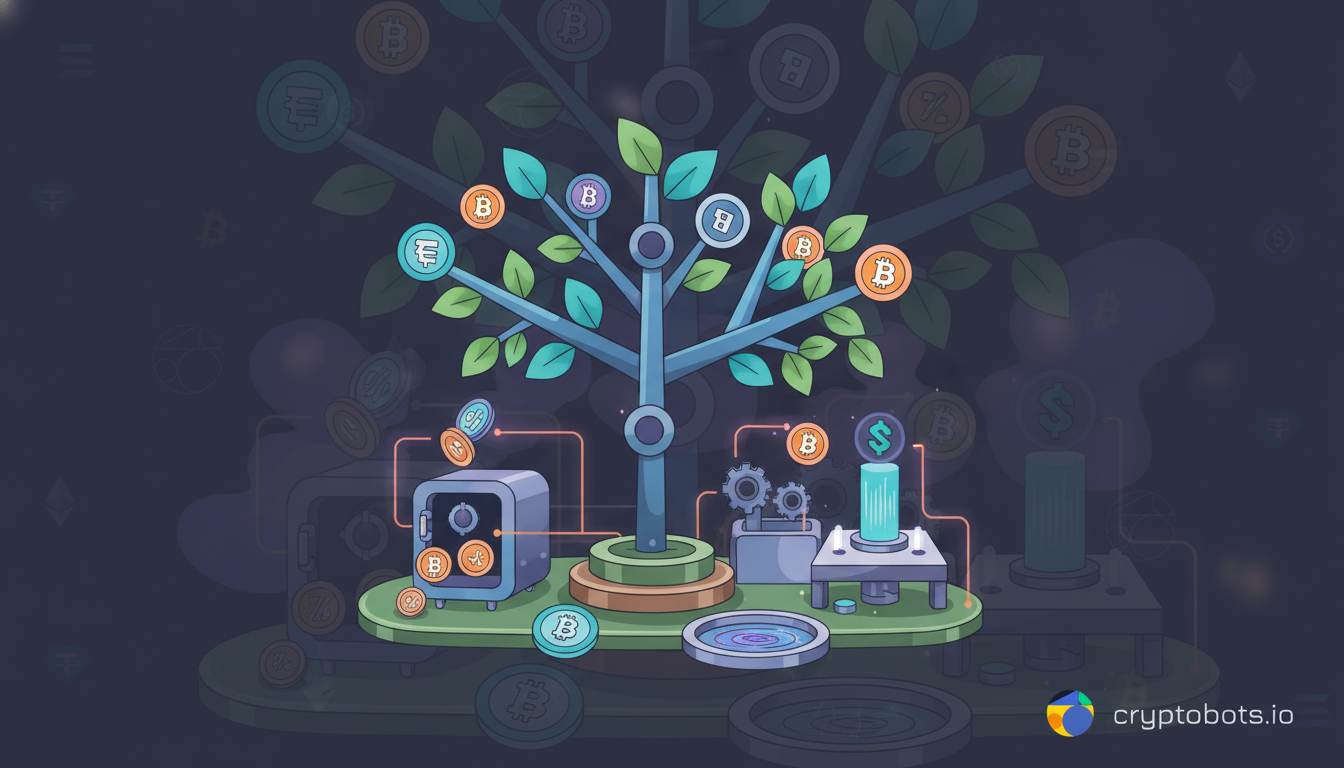
Generating yield from digital assets requires matching your capital and technical comfort with the right mechanism. For investors seeking crypto passive income: 10 ways to earn stand out in 2026, spanning proof-of-stake network validation, decentralized lending, automated algorithmic trading, and infrastructure operation. Every method carries distinct risk profiles, from smart contract vulnerabilities to market volatility.
You can get started with zero upfront cost on Cryptobots.io, where automated algorithms execute trades directly inside your exchange account via API keys, charging fees only on profitable trades.
Here is a practical breakdown of how crypto yield generation works today and how to evaluate the primary strategies available to investors.
How crypto yield generation works in 2026
Crypto passive income means earning yield on digital holdings without executing manual trades or following order books every day. Instead of relying only on long-term price appreciation, you allocate capital into blockchain networks, smart contract pools, or systematic trading software that pay ongoing returns.
In earlier market cycles, passive returns relied heavily on inflationary token emissions or uncollateralized lending desks. In 2026, market participants prioritize real yield: cash flow derived from genuine transaction fees, borrowing demand, or verified trading performance.
Before depositing capital into any income strategy, evaluate four structural factors:
Risk profiles vary sharply across strategies. High projected yields almost always signal structural hazards, such as unverified smart contract code, illiquid collateral, or inflationary reward tokens.
Net yield matters more than gross APY. You need to account for compounding frequency, network gas fees, platform service charges, and token price changes over time.
Asset liquidity determines how fast you can exit. Certain protocols lock capital for days or weeks, which prevents rapid adjustments when market conditions deteriorate.
Operational requirements range from set-and-forget setups to strategies requiring periodic rebalancing. A viable passive strategy should fit your schedule without demanding constant manual oversight.
1. Staking: Securing networks and earning validation rewards
Staking remains one of the most reliable methods to earn native yield on Proof-of-Stake (PoS) blockchains. By locking tokens into a validator node or delegation pool, you help validate transactions and maintain network consensus. In return, the protocol pays you network transaction fees and newly minted coins.
Individual token holders can stake by running a dedicated validator node or delegating holdings through non-custodial wallets like MetaMask, Phantom, or hardware wallets. Liquid staking protocols offer another path by issuing derivative tokens (such as stETH), which let you collect underlying staking rewards while keeping the capital liquid for use in decentralized finance.
Major PoS networks supporting active staking include Ethereum (ETH), Solana (SOL), Cardano (ADA), and Polkadot (DOT). Annual yields generally range between 3% and 8%, depending on total network participation rates and transaction volume.
Staking delivers predictable returns paid in native tokens with minimal daily management. The principal risks include asset price volatility during lockup periods and potential validator slashing penalties if node software experiences prolonged downtime or double-signing errors.
2. Yield farming: Capturing dynamic returns in DeFi
Yield farming involves moving digital assets across decentralized finance (DeFi) protocols to capture maximum yield. Farmers supply tokens to lending markets, deposit pair balances into automated market makers, or lock liquidity provider tokens inside yield optimization vaults.
You deposit crypto into smart contract pools, and the protocol pays returns in swap fees, interest payments, or governance tokens. Automated yield aggregators auto-compound these rewards by periodically selling earned tokens and reinvesting the proceeds into the underlying principal, accelerating long-term compounding speeds.
Yield farming often delivers higher annual percentage yields than basic network staking, particularly during active market cycles when trading volume and borrowing demand increase. It also gives liquidity providers early access to protocol governance tokens.
However, smart contract risks are significant. Code exploits can lead to capital loss, and reward token values often decline when protocol emission schedules taper off. Managing yield farms requires evaluating contract audits and monitoring pool balances regularly.
3. Crypto lending: Earning interest on capital reserves
Crypto lending operates on a straightforward model: you supply capital to a lending pool, borrowers take loans using crypto as collateral, and you collect interest on the lent balance. Stablecoins like USDC and USDT are widely used in lending strategies because they shield principal values from market drops.
Lending runs through centralized crypto institutions or decentralized protocols like Aave and Compound. In DeFi lending, smart contracts manage collateral ratios automatically, executing liquidations if a borrower’s collateral value drops below required thresholds.
Lending produces predictable cash flow with lower price volatility than yield farming, making it popular for defensive portfolios. Flexible withdrawal terms usually allow you to withdraw funds as needed.
Centralized lending platforms expose lenders to counterparty and platform solvency risks. Decentralized lending removes counterparty risk but introduces smart contract vulnerabilities and potential liquidation delays during extreme market crashes. Interest rates also fluctuate constantly based on borrowing demand.
4. Liquidity provision: Powering decentralized exchanges
Decentralized exchanges depend on liquidity providers (LPs) to facilitate token swaps without traditional order books. When you act as an LP, you deposit an equal value pair of tokens (such as ETH and USDC) into a smart contract liquidity pool. Every time a trader swaps tokens in that pool, a fee is distributed proportionally among liquidity providers.
To start, you connect a Web3 wallet to a DEX like Uniswap or PancakeSwap, select an asset pair, and approve the deposit. The DEX mints LP tokens representing your proportional ownership of the pool, accruing swap fees automatically over time.
Liquidity provision directly captures transaction fees from market trading activity. High-volume pools on popular trading pairs can generate substantial cash flow during volatile market periods.
The main challenge is impermanent loss. If one asset in the pair appreciates or depreciates significantly relative to the other, the pool’s automated market maker rebalances your holdings. This leaves you with a lower total dollar value than simply holding the raw tokens in a wallet. Concentrated liquidity models allow providers to mitigate this risk by setting custom price ranges for fee collection.
5. Automated trading bots: Systematic execution with Cryptobots.io
Automated trading bots follow predefined algorithmic rules to trade exchange order books around the clock. While staking and lending generate yield from locked principal balances, trading bots aim to capture profit from short-term price movements in both rising and falling markets.
Bot software connects to your exchange account using restricted API keys. The system monitors technical indicators, places orders, and manages position sizing based on strict risk protocols.
Cryptobots.io provides quantitative trading strategies designed for consistent performance without monthly fees. The platform operates on a profit-sharing model: you pay a 33% fee only on realized net profits after the system executes winning trades for your account.
Account safety relies on strict API architecture. Cryptobots.io uses trading-only permissions that strictly block fund withdrawals, meaning your assets never leave your exchange account. The underlying algorithms operate with conservative leverage (capped at 1.0x for inverse contracts and 1.5x for linear derivatives) and incorporate a 40% safety net to manage market drawdowns.
Investors can choose specialized strategies built for major market assets using dedicated options like Bitcoin Bots and Ethereum Bots.
Algorithmic execution removes human emotional bias and operates continuously without manual chart analysis. The primary risk stems from sudden market pullbacks, which the platform manages through conservative position sizing and automated risk boundaries.
6. Cloud mining: Renting hardware hash power
Mining Bitcoin directly requires specialized ASIC hardware, industrial power connections, and dedicated cooling infrastructure. Cloud mining allows investors to rent computing power hosted in remote data centers instead of purchasing and operating physical machines.
You select a cloud mining provider, purchase a specific hash rate contract, and direct the processing power to a mining pool. The hosting facility manages equipment installation, electrical maintenance, and hardware cooling, depositing daily block rewards directly into your account balance.
Cloud mining eliminates physical hardware setup, electricity upgrades, heat generation, and fan noise, making cryptocurrency mining accessible to non-technical users.
However, historical returns are often lower than holding native assets outright after subtracting hosting and maintenance fees. Scam operations remain common in the cloud mining space, making facility verification, equipment proof, and contract audit checks mandatory before allocating capital.
7. Play-to-Earn economies: Monetizing gaming assets
Play-to-Earn (P2E) platforms combine blockchain tokens and non-fungible tokens (NFTs) with interactive gaming mechanics. Players earn tradeable tokens by completing in-game objectives, winning competitive matches, or leasing digital assets to active players.
To generate passive yield, investors purchase valuable in-game assets, land parcels, or character NFTs and rent them out via gaming guilds or direct peer-to-peer agreements. Borrowers use the assets to play, sharing a percentage of earned utility tokens with the asset owner.
P2E asset leasing provides cash flow from digital gaming assets without requiring daily gameplay from the owner.
Token values depend entirely on active player retention and sustainable game economics. Many P2E utility tokens experience heavy inflation as token supplies grow, and underlying NFT asset values can decline rapidly if player interest fades.
8. Running a masternode: Supporting network infrastructure
Masternodes are dedicated full nodes that perform advanced network functions beyond standard block validation. They process private transactions, enable instant settlements, and participate in decentralized governance voting across supporting blockchain networks.
To operate a masternode, you lock a required amount of native cryptocurrency as collateral in a wallet and maintain a server connected to the network continuously. In exchange for server uptime and network processing, the protocol distributes a portion of block rewards to node operators.
Masternodes generally offer higher yield percentages than standard delegation staking, along with voting rights on protocol treasury proposals. Networks like Dash and PIVX utilize masternode architecture for specialized transaction handling.
The barriers to entry include high initial capital and technical setup requirements. Required collateral frequently totals tens of thousands of dollars, and maintaining Linux server infrastructure demands ongoing technical care to avoid offline downtime penalties.
9. Crypto affiliate programs: Earning referral commissions
Exchanges, software developers, and trading platforms operate affiliate programs that reward creators, marketers, and users for introducing new active clients. This model turns community networks and content channels into recurring crypto revenue without direct market capital risk.
You apply for an affiliate link, share it across your website, newsletter, or social channels, and earn commissions based on your referrals’ activity. Payout structures include percentage fee splits, flat sign-up rewards, or recurring performance cuts paid in crypto or fiat.
The Cryptobots.io Affiliate Program offers a 25% share of the profit split collected from your referred traders, creating recurring passive cash flow without requiring an initial deposit.
Affiliate income carries zero direct trading risk and scales with audience growth. Success depends on reaching active traders and crypto users who regularly interact with digital asset services.
10. Crypto savings accounts: Yield on idle exchange balances
Crypto savings accounts offer a familiar way to earn interest on digital assets. Offered by centralized crypto exchanges and institutional custodians, these accounts pay fixed or variable interest on deposited balances.
You deposit supported cryptocurrencies or stablecoins into an interest-bearing account. The provider generates yield by lending funds to institutional borrowers or deploying capital into institutional DeFi protocols, distributing payouts daily, weekly, or monthly.
Savings accounts require no technical configuration or wallet maintenance, making them convenient for managing idle cash reserves or long-term holdings.
Yields are generally lower than direct DeFi lending, and deposits carry custodian counterparty risk. Evaluating platform security practices, reserve audits, and corporate registration is critical before depositing capital.
Risk and return comparison
Building a balanced crypto passive income portfolio involves aligning strategy risk levels with your investment horizon and technical capabilities. Diversifying capital across multiple yield sources helps protect your total portfolio against single-protocol failures or market shifts.
Higher-risk options include yield farming, early-stage P2E asset leasing, and masternode hosting. These strategies offer higher potential returns but demand technical expertise, smart contract scrutiny, and active risk monitoring.
Moderate-risk options include network staking, concentrated liquidity provision, and automated algorithmic trading. These methods offer a practical balance between system security, capital control, and consistent yield execution.
Lower-risk options include regulated custodial savings accounts, stablecoin lending on major DeFi protocols, and affiliate referral programs. These setups provide straightforward access with low operational complexity.
Always avoid committing capital you cannot afford to lose, and test new protocols with small balances before committing significant funds.
FAQ about crypto passive income
How safe is crypto passive income?
Safety depends entirely on the chosen strategy. Staking directly on major Layer-1 networks carries lower risk than supplying capital to unverified yield farming pools. General risks across all options include crypto market volatility, smart contract bugs, platform insolvency, and impermanent loss in liquidity pools.
What is the easiest passive income strategy for beginners?
On-chain delegation staking through personal non-custodial wallets and exchange savings accounts are the most accessible entry points. Automated tools like Cryptobots.io also offer beginners a straightforward path to run quantitative strategies directly within their existing exchange accounts without managing smart contracts manually.
Can I earn passive crypto returns with a small starting balance?
Yes. Staking pools, DEX liquidity pools, and automated trading platforms accept modest initial deposits. Affiliate programs require zero initial capital, making them accessible to anyone with an active audience or community network.
How are passive crypto earnings taxed?
In most tax jurisdictions, crypto yield rewards like staking payouts, interest distributions, and trading gains are classified as taxable income based on their fair market value when received. Selling those assets later can also trigger capital gains taxes. Maintain clear transaction records and consult a qualified tax professional.
How do automated bots generate passive return?
Automated trading bots execute predefined trading rules based on market price movements and order book data. Platforms like Cryptobots.io trade systematically within your exchange account, using disciplined position sizing and risk controls to capture profit without manual trade execution.
Build your passive crypto strategy in 2026
Building sustainable crypto passive income in 2026 comes down to choosing transparent models backed by real yield over unrealistic short-term promises. Whether you stake native tokens, supply liquidity, or deploy automated trading software, managing downside exposure is essential for long-term growth.
Automated trading strategies from Cryptobots.io provide a disciplined, transparent way to capture market moves. With zero upfront fees, an API-only architecture that keeps capital in your exchange account, and a pure profit-sharing structure, you retain control of your funds while deploying systematic trading strategies.
Ready to put your idle capital to work? Visit Cryptobots.io to explore verified performance records and get started today.