
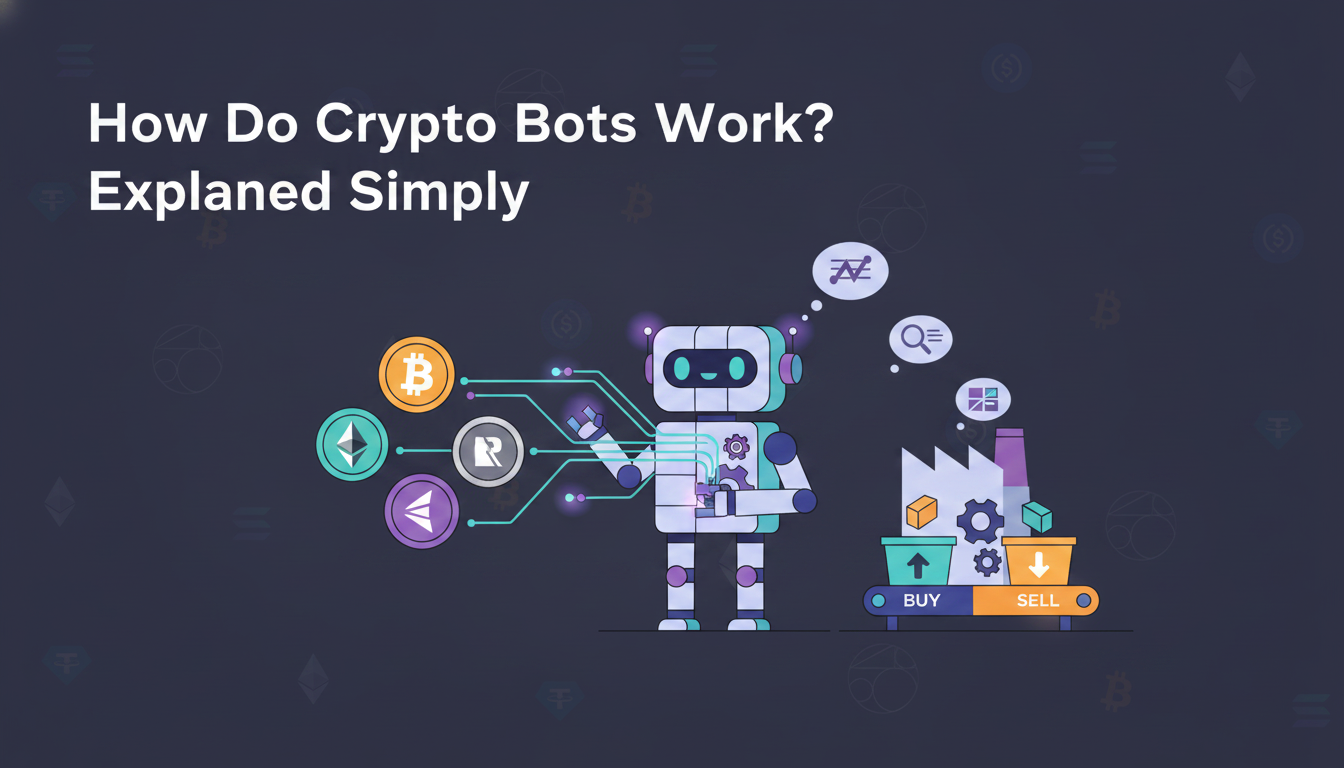
Crypto bots are automated software programs that connect directly to cryptocurrency exchanges to execute buy and sell orders based on rules you configure. Instead of opening charts manually and submitting trades line by line, you establish baseline parameters that instruct the software when to enter or exit positions.
Automated execution operates continuously, but it cannot eliminate market risk. Prices move unpredictably during volatility spikes, meaning automated strategies can still lose money if market conditions shift against your parameters.
Modern trading systems communicate with your exchange via encrypted API keys, ensuring your funds stay inside your existing exchange wallet. You can get started with zero upfront cost on CryptoBots.io, where software fees only apply when your active bots produce net profits.
What is a crypto bot?
A crypto bot serves as an execution engine running alongside your exchange account. The application reads incoming ticker data, tracks balance changes, and transmits trade orders whenever price movements match the instructions in your trading model.
Once activated, the application executes trades independently. It monitors markets continuously and places trades at computer speeds, ignoring fatigue or emotional hesitation.
Why traders turn to automation
Manual cryptocurrency trading presents distinct structural difficulties. Because crypto exchanges operate 24 hours a day without market closes, human traders inevitably miss price movements that occur during sleep or work hours. Physical limitations make it difficult to monitor multiple trading pairs across different exchanges at the same time.
Psychological pressure also degrades manual execution. When prices move violently, fear often prompts traders to close winning positions too early, while greed leads them to hold losing positions past reasonable stop levels. Automated software adheres strictly to pre-set parameters, removing emotional hesitation during volatile price moves.
If you want how do crypto bots work explained in plain terms, the answer lies in systematic execution. The software translates technical indicators and price thresholds into automated instructions, monitoring multiple order books simultaneously and placing orders within milliseconds of a valid signal.
Core components of automated trading software
A standard trading bot relies on five connected technical modules working together:
- Market data connector: Fetches real-time price quotes, depth charts, and trade histories directly from exchange servers.
- Strategy engine: Analyzes incoming price data against your chosen technical rules to decide whether to buy, sell, or hold.
- Risk management module: Checks trade sizing, sets protective stop orders, and enforces maximum exposure limits before any order goes out.
- Execution engine: Transmits formatted order commands directly to exchange endpoints through secure API connections.
- Backtesting framework: Runs strategy rules against historical market data so you can review potential returns and drawdown risk before deploying live funds.
How automated bots execute trades on exchanges
Understanding automated trading requires looking at how external software communicates securely with your central exchange account.
API integration and security
Communication between trading software and exchanges relies on Application Programming Interfaces (APIs). An API key works like a secure access token that allows an external software application to perform specific account actions on your behalf.
When connecting software to platforms such as Binance, Coinbase, or Kraken, you create an API key inside your exchange security settings and set permissions. Secure configurations restrict access to two basic functions: read access for account balances and price feeds, and trade access for placing or canceling orders.
Withdrawal permissions should never be granted to external software. Platforms like CryptoBots.io operate strictly through trade-only API connections. Your capital stays inside your exchange wallet, preventing any external system from withdrawing funds.
Technical logic and strategy conditions
The core strategy engine evaluates incoming ticker data against specific logical rules. Basic setups use technical indicators like moving averages, the Relative Strength Index (RSI), MACD, or Bollinger Bands to detect price trends.
Advanced models track price movements across key support and resistance zones, monitor sudden shifts in trade volume, or scan for momentary price gaps between liquid markets. When incoming market data meets your defined conditions, the engine triggers an execution request immediately.
Real-time execution loop
When running continuously, trading software follows a distinct execution cycle:
- Data collection: Receives live order book entries and tick prices directly from the exchange.
- Parameter evaluation: Compares active market quotes against strategy conditions.
- Order creation: Formulates exact limit or market orders the moment conditions line up.
- API delivery: Sends order requests to the exchange matching engine over low-latency connections.
- Position management: Tracks open orders and places protective stop-loss or profit-taking orders as soon as initial fills clear.
Popular crypto bot strategies
Automated bots run various strategies based on prevailing market conditions and individual risk tolerance.
Trend following
Trend following systems aim to capture extended directional price moves. When technical indicators show a sustained upward trend, the bot enters a long position and holds it until momentum indicators signal a reversal. In downward trends, systems can move funds into stablecoins or take short positions when trading derivative contracts.
Arbitrage
Arbitrage strategies profit from temporary price discrepancies for the same asset across different exchanges. If Bitcoin trades for $65,000 on one platform and $65,150 on another, an arbitrage bot buys on the cheaper exchange while selling on the higher-priced exchange simultaneously. Because these price gaps disappear quickly, fast computer execution is essential.
Market making
Market making bots place buy and sell limit orders on both sides of the order book around the current market price. By capturing the spread between bid and ask offers, the bot accumulates small gains across many transactions. This setup relies on consistent market volume and narrow spreads to operate effectively.
Grid trading
Grid trading builds a ladder of buy and sell limit orders at regular intervals within a preset price channel. As the asset fluctuates inside the range, the bot buys near lower grid levels and sells at higher grid levels. This strategy creates steady execution during sideways, range-bound market phases.
Dollar-cost averaging (DCA)
DCA strategies make recurring purchases of a target asset at scheduled time intervals regardless of short-term price movements. Buying fixed dollar amounts over time smooths out short-term price volatility and lowers the average entry price across market cycles.
CryptoBots.io offers pre-built strategies optimized for both linear USD-settled pairs and crypto-settled inverse contracts, allowing traders to align execution with their preferred collateral asset.
The CryptoBots.io approach: automated trading without monthly fees
Many software platforms charge fixed monthly fees whether your trades turn a profit or lose money. CryptoBots.io uses a performance-aligned model designed to eliminate fixed recurring software overhead.
Zero upfront costs and performance alignment
Instead of flat monthly charges, CryptoBots.io uses a profit-sharing model:
- No setup fees or mandatory monthly software fees
- No hidden platform maintenance charges
- A 33% profit share applied only to net gains realized by your active bots
If your active strategies do not yield net profits, you pay no software fees. You can review the specifics on our Profit Share model page.
Non-custodial API architecture
Your crypto assets remain stored inside your personal exchange account at all times. By connecting via trade-only API keys, CryptoBots.io handles automated order execution on exchanges like Binance, Coinbase, or Kraken without ever holding withdrawal permissions.
Risk controls and verified results
To help manage downside exposure during market drops, CryptoBots.io keeps strategy leverage conservative at or below 1.0x for inverse contracts and 1.5x for linear derivatives while building a 40% safety net into core risk parameters. Historical performance data and trade logs are available on our Proof of Performance page.
Flexible strategy selection
Whether you focus on Bitcoin, Ethereum, Solana, or stablecoin pairs, you can select strategies designed for specific market regimes. Review current options inside our Strategy Explorer or read our breakdown on building automated routines on the Passive Income page.
Setting up an automated trading bot
Setting up an automated trading bot requires no coding background or server maintenance.
1. Select a non-custodial execution platform
Choose a platform that uses trade-only API connections, provides explicit risk controls, and uses transparent fee terms. Non-custodial execution ensures your capital stays inside your personal exchange account rather than a third-party platform wallet.
2. Create trade-only API keys
Log into your exchange account and generate a new set of API keys. Turn on reading and trading permissions, but leave withdrawal permissions unchecked. Copy the API key and secret into your platform control panel to establish a secure link. You can view step-by-step connection instructions on our Get Started page.
3. Pick a strategy and set position limits
Select a pre-built strategy suited to current market trends and your preferred risk level. Choose between linear USD contracts or inverse crypto setups, then define the total capital allocation assigned to the strategy.
4. Track performance from your dashboard
Once active, the system executes trades automatically based on your strategy rules. Use the dashboard interface to view open trades, check performance statistics, and modify settings whenever market conditions shift.
Frequently asked questions
How secure are automated trading bots?
Security depends on how the software connects to your exchange. Systems that use trade-only API keys allow software to place orders on your exchange without providing withdrawal access. Your funds remain inside your exchange wallet at all times.
Do I need programming skills to use a trading bot?
No. Modern trading platforms provide pre-configured strategies along with visual management dashboards. You link your exchange API keys, select your strategy settings, and activate trading without writing any code.
Can crypto bots guarantee positive returns?
No trading system can guarantee profitable returns. Unexpected news, market volatility, and sudden drops in liquidity impact automated strategies alongside manual ones. Automated bots execute rules faster and eliminate emotional mistakes, but market risk remains.
How much capital is required to start?
Minimum starting capital depends on your exchange’s minimum order sizes and your selected strategy. CryptoBots.io requires no upfront platform fees, though your exchange balance must satisfy standard order minimums set by the exchange.
How do I choose the right bot strategy?
Select a strategy based on market trends and your risk tolerance. Dollar-cost averaging suits long-term accumulation, grid trading works best during sideways price ranges, and trend following fits clear directional moves. You can evaluate strategy options inside our Strategy Explorer.
Conclusion
Understanding how crypto bots work comes down to systematic execution. Automated software converts predefined strategy rules into quick, disciplined trade orders without requiring manual market watching around the clock.
If you want systematic execution without recurring monthly software fees or handing over custody of your coins, CryptoBots.io offers a secure, performance-aligned platform. Capital remains inside your personal exchange account, and you pay fees only when your active bots generate net profits.
Start automating your trading strategies today. Visit CryptoBots.io to get started with zero upfront cost.