
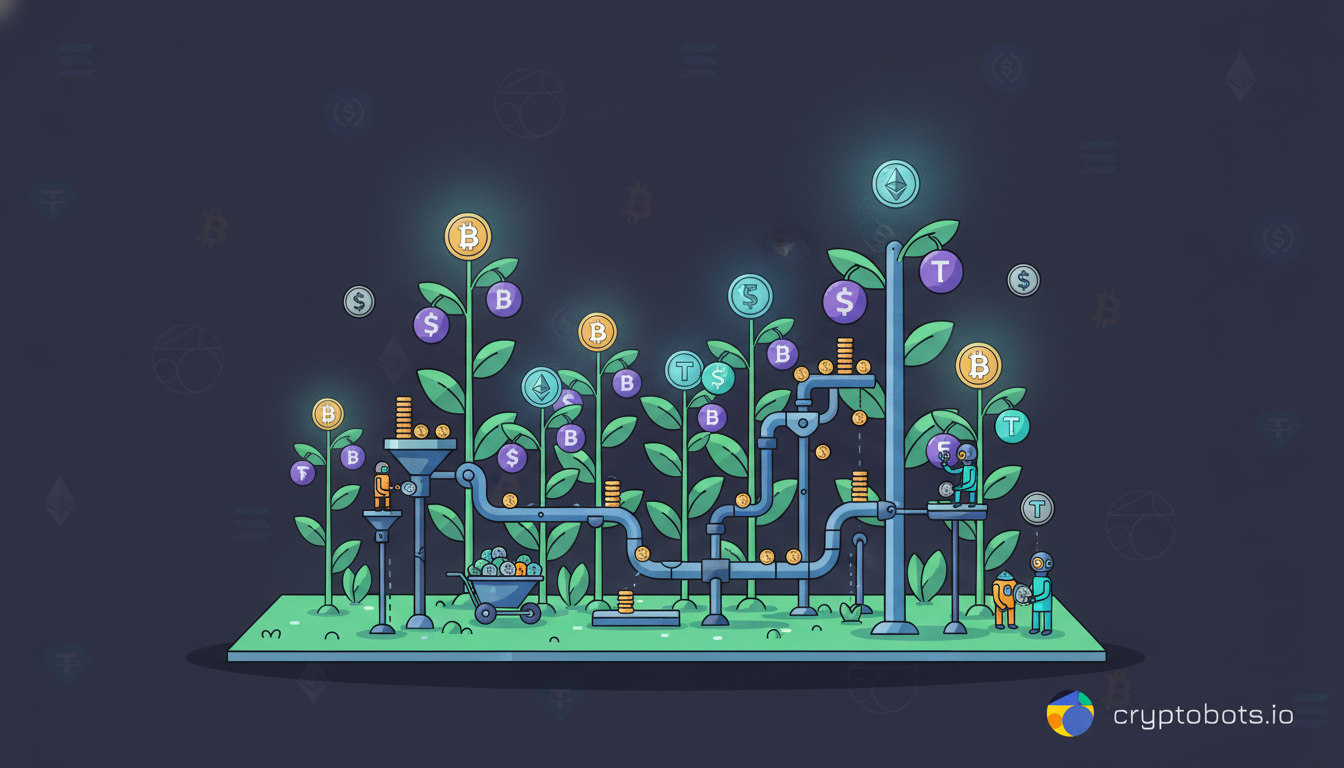
Earning crypto passive income comes down to putting digital assets to work through protocol rewards, liquidity fees, or automated trading strategies rather than actively timing market swings. Every method carries real risks, from smart contract failures to portfolio drawdowns during deep market drops.
With algorithmic trading, you can execute systematic strategies directly on your exchange while keeping full custody of your funds. You can get started with zero upfront cost and pay performance fees only when your account locks in net profits.
Primary methods to earn crypto passive income
Investors seeking recurring cashflow from digital assets generally rely on three foundational mechanisms: protocol staking, liquidity provision, and automated algorithmic trading. Understanding how each engine generates returns helps you pick the right approach for your capital and risk tolerance.
Staking and network participation
Proof of Stake blockchains such as Ethereum, Solana, and Cardano compensate token holders for locking up assets to validate transactions and maintain network security. As explained in the Binance Academy staking guide, validators earn newly minted tokens alongside a fraction of network transaction fees.
Native staking offers a clear path to accumulate base assets. Returns generally hover between 3% and 8% annually, depending on total network participation and validator uptime.
The main drawback of staking is token illiquidity. Most networks impose unbonding periods ranging from several days to several weeks. During this lockup window, your capital remains inaccessible while exposed to market price movements. Because yields are paid in the underlying native asset, a 30% drop in token price quickly wipes out nominal staking gains.
Liquidity mining and yield farming
Decentralized exchanges rely on automated market makers rather than traditional order books. Investors deposit paired tokens, such as ETH and USDC, into liquidity pools so other traders can swap between assets. In return, liquidity providers collect a fee on every transaction passing through the pool, alongside occasional secondary governance tokens.
While yield farming can generate high annual percentage yields during active market cycles, it introduces structural risks. The biggest hazard is impermanent loss. This occurs when the relative price of your deposited assets diverges significantly from when you added them to the pool. If one token surges or plummets while the other stays flat, your combined pool value will end up lower than if you had simply held both tokens in a standard wallet.
Automated algorithmic trading
Algorithmic trading uses software to execute buy and sell orders based on predefined rules, grid logic, or momentum signals. Staking pays fixed protocol rewards regardless of price trends, but trading algorithms aim to extract cashflow straight from ongoing market volatility.
By running execution rules across 24-hour exchange liquidity cycles, algorithms capture short-term price movements in both rising and falling markets. Modern setups connect directly to top centralized exchanges through restricted Application Programming Interfaces (APIs). This structure keeps your main balance inside your personal exchange account while software handles trade timing.
Comparing passive income methods: staking, yield farming, and trading bots
Selecting an income strategy requires evaluating capital lockup rules, operational maintenance, performance in market downturns, and security risks.
| Category | Staking | Liquidity Mining | Automated Trading Bots |
|---|---|---|---|
| Primary Yield Source | Network inflation & gas fees | DEX trading fees & token rewards | Market volatility & order execution |
| Capital Lockup | Often required (days to weeks) | Minimal (immediate DEX withdrawal) | None (funds stay in exchange) |
| Bear Market Resilience | Low (dollar value falls with token) | Low (impermanent loss risk) | High (can short or trade stablecoin pairs) |
| Setup Complexity | Low to Moderate | High (requires DEX interaction) | Low (API key connection) |
| Counterparty Risk | Protocol smart contracts / validators | DEX smart contracts & pool imbalances | Exchange security & API management |
Traditional staking and yield farming work best during sustained bull markets when token values rise. When markets enter sideways ranges or sharp drops, basic protocol rewards rarely offset spot price declines.
Automated strategies focus on trade execution rather than network emissions. By capturing continuous price movements, software can turn daily volatility into realized gains. To see how systematic execution fits into a broader cashflow plan, read more on how to build crypto passive income using systematic asset management.
How automated bots generate cashflow in any market
Using trading bots to build passive yield requires capturing price movement while keeping strict caps on downside risk. Fast crypto price swings create frequent order book inefficiencies that manual traders miss when away from their screens.
Settlement mechanics: inverse vs. linear derivatives
Automated trading software structures trades around two main contract types depending on your financial targets:
Inverse derivative strategies use base assets like Bitcoin or Ethereum as trading collateral. Profitable trades pay out in the underlying cryptocurrency, allowing long-term holders to increase their total coin count during flat or upward cycles.
Linear derivative strategies use stablecoins like USDT or USDC for margin and settlement. Profitable trades yield immediate stablecoin earnings, locking in dollar-pegged cashflow that stays unaffected by broader market pullbacks.
Risk controls and capital preservation
Building sustainable income requires strict position controls. High leverage and unhedged balances cause the vast majority of retail trader liquidations.
Practical algorithmic systems rely on three main risk rules:
- Position sizing stays within strict boundaries, typically capped at 1.0x for inverse contracts and 1.5x for linear derivatives to prevent liquidation from brief market spikes.
- Risk parameters include safety buffers, such as a 40% liquidation distance, allowing positions to absorb rapid market moves.
- Security relies on API-only connections, so you never send funds to a vendor wallet. The software connects to your exchange using restricted trading keys.
By keeping these safety rules in place, platforms like CryptoBots.io handle trade execution on your account while maintaining low leverage. You retain exclusive control over withdrawal permissions.
Step-by-step: setting up your automated crypto passive income stream
Setting up an automated yield strategy through an API-connected system requires no programming background and takes only a few minutes.
Step 1: Select your strategy and target asset
Decide whether your priority is building base crypto reserves or earning stablecoin cashflow. If you want to grow your total Bitcoin balance over time, select an inverse contract strategy focused on BTC accumulation. If you prefer predictable dollar-denominated returns, choose a linear stablecoin strategy. You can review specialized algorithms like our Bitcoin bots to align with your asset targets.
Step 2: Configure API keys on your exchange
Sign in to your primary exchange account on platforms like Binance, Coinbase, or Kraken. Go to the API Management section and generate a new key pair for your trading software.
Set key permissions with care:
- Enable Reading so the software can check current balance data and active orders.
- Enable Spot or Futures Trading so the system can place and close orders.
- Disable Withdrawals to keep funds safe. Unchecking withdrawal access guarantees that even if an API key is compromised, capital cannot be transferred off the exchange.
Step 3: Link your API keys to the strategy dashboard
Copy your public API Key and Secret Key from your exchange account, then paste them into your strategy dashboard. Once connected, the platform verifies key permissions and prepares execution logic.
Step 4: Monitor performance and profit-share alignment
Once active, the system monitors market conditions and places trades whenever strategy parameters match market data. Look for performance-based models rather than upfront monthly software fees.
Under a performance arrangement, you pay fees only after your account locks in net returns. Reviewing the profit share model shows how a 33% profit share aligns incentives, meaning the platform earns revenue only when your portfolio makes money.
+-------------------------------------------------------------------+
|                     AUTOMATED ENGINE SETUP                        |
+-------------------------------------------------------------------+
|                                                                   |
|   +-------------------+        API Keys        +--------------+   |
|   |  Crypto Exchange  | <--------------------> | Trading Bot  |   |
|   | (Binance/Kraken)  |  (Trade Access Only)   |  Algorithms  |   |
|   +-------------------+                        +--------------+   |
|             |                                         |           |
|             v                                         v           |
|   +-------------------+                        +--------------+   |
|   | Funds Stay In     |                        | Executes 24/7|   |
|   | User Control      |                        | Trades Net   |   |
|   +-------------------+                        +--------------+   |
|                                                                   |
+-------------------------------------------------------------------+
Key risks and how to protect your capital
Every passive income method carries financial and technical risks. Protecting your balance requires active risk management and realistic return goals.
Exchange counterparty risk
Even when your trading software is secure, your capital lives on a centralized exchange. If that exchange experiences technical outages or solvency issues, your funds can be locked up.
To lower this risk, stick to established exchanges with deep order book liquidity and verifiable proof of reserves, such as Binance, Coinbase, or Kraken. Avoid unverified platforms offering high fee rebates.
Volatility and drawdown risk
Crypto asset prices can shift rapidly in short periods. If a long trade opens right before an unexpected drop, unhedged positions will show unrealized losses.
As detailed in financial risk resources on Investopedia, effective income strategies focus on risk mitigation over aggressive position sizing. Keep leverage between 1.0x and 1.5x and use stop-loss logic to exit positions before drawdowns grow large.
Vendor and software scams
The automated trading space contains products claiming fixed daily returns, such as guaranteed 1% daily yields. In liquid digital asset markets, fixed return promises are unfeasible and often indicate Ponzi structures.
Avoid any service requiring direct wallet deposits to access trading logic. Require non-custodial API architecture and demand verifiable trade data. Review setup guides such as our guide on crypto trading bot automation to learn how to check strategy settings securely.
Frequently asked questions
How much capital do I need to start earning crypto passive income?
Minimum capital limits depend on your exchange and chosen strategy. Most top exchanges accept API trading orders on balances starting around $50 to $100. Starting with $500 to $1,000 gives the strategy more room to split position sizes and handle temporary price drawdowns without hitting margin bounds.
Is crypto passive income truly hands-free?
Trading bots run order logic around the clock without manual intervention, but no strategy is completely set and forget. You should check your exchange dashboard regularly to track realized returns, follow exchange security notices, and review strategy performance against market benchmarks.
Can you earn passive income during a crypto bear market?
Yes. Unlike spot asset holdings or protocol staking where reward fiat value drops alongside market prices, trading bots can earn yield in falling markets. Linear derivative bots can open short positions or trade range-bound volatility, collecting stablecoin gains regardless of broader market trends.
What is the safest way to connect an automated trading bot?
The safest method is using restricted exchange API keys with read and trade permissions enabled while withdrawal settings remain turned off. This setup permits the trading software to evaluate price data and execute orders within your exchange account, but prevents it from transferring or withdrawing funds.
Start building your automated crypto cashflow today
Building steady crypto passive income requires balancing risk, liquidity, and setup effort. Protocol staking and yield farming offer basic ways to earn native tokens, but automated trading provides a flexible method to generate yield from ongoing market volatility.
Using API execution keeps your funds inside your exchange balance while software handles order timing around the clock. With conservative leverage limits, transparent performance fees, and zero upfront subscriptions, platform goals match your portfolio outcomes.
You can take the next step toward systematic portfolio management today. Go ahead and launch your automated strategy today with zero upfront costs to build a sustainable digital asset cashflow stream.