
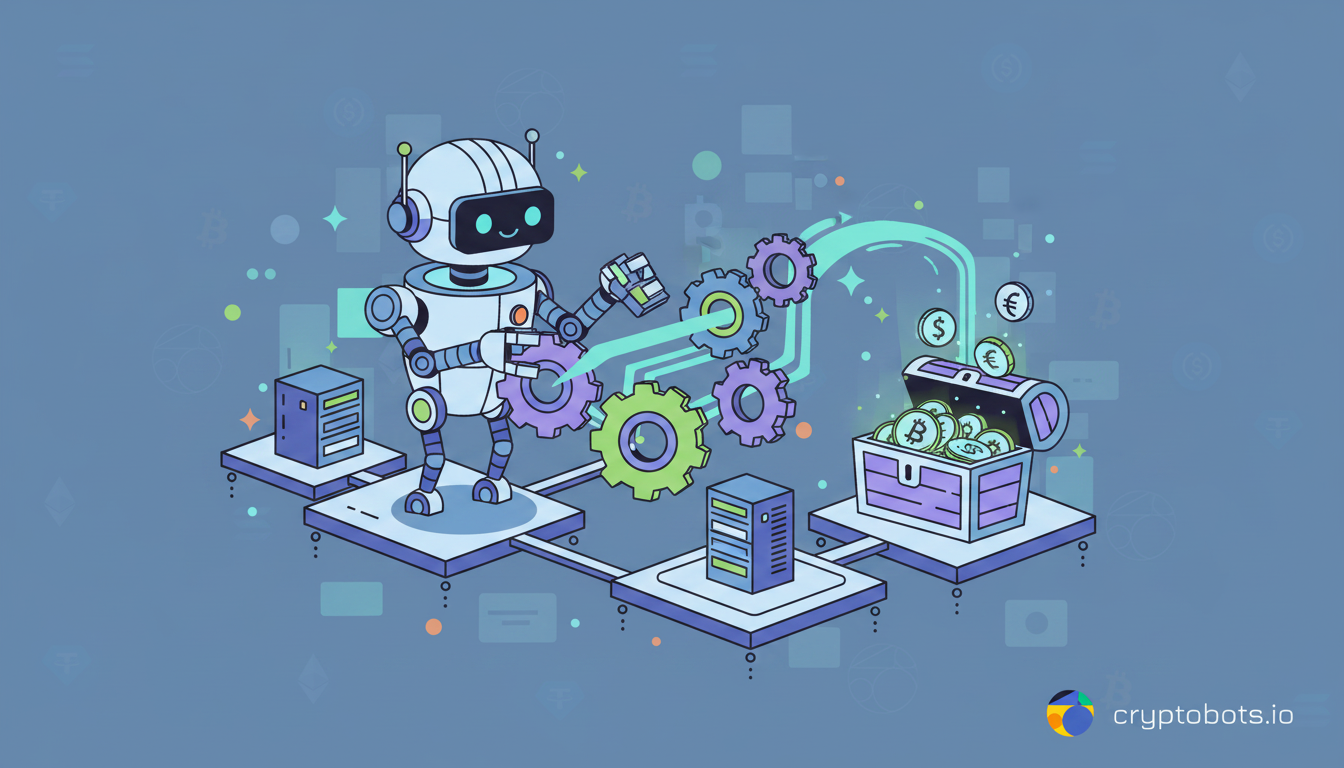
Setting up automated crypto trading involves picking an algorithmic strategy, connecting your exchange account using read-and-trade API keys, and defining strict risk parameters. While automated systems execute orders systematically without emotional fatigue, cryptocurrency markets carry financial risk, and algorithms cannot guarantee positive returns. Non-custodial setups keep your capital inside your personal exchange wallet while eliminating monthly software fees. You can get started with zero upfront cost on CryptoBots.io and pay a 33% fee only on realized net profits.
How automated crypto trading works
Manual trading demands constant attention to order books, price charts, and position sizing across volatile assets. Digital asset exchanges operate continuously without closing bells. Sharp price swings frequently happen overnight or during busy work hours, making around-the-clock manual oversight difficult.
Automated systems bridge this gap by connecting directly to exchange application programming interfaces (APIs). The software processes market data, calculates order amounts, and executes trades according to predefined rules.
Automating trade execution offers distinct operational advantages. Software continuously monitors liquidity and price patterns, taking orders instantly when conditions match a strategy rule. Systematic rules remove impulse choices, like cutting winning trades early or holding losing positions in hope of a quick recovery. Programmed parameters also apply stop losses and position limits evenly across every trade. Instead of staring at charts all day, you can focus on selecting strategies and managing overall asset allocation.
Algorithmic execution also changes how you manage a digital asset portfolio over longer time horizons. Automated strategies capture incremental swings across full market cycles. Reliable platforms build risk controls, leverage limits, and margin buffers directly into execution routines. You can run algorithms across Bitcoin, Ethereum, and altcoins at the same time without compounding your daily workload. Web-based systems eliminate the need to write custom code, letting you connect exchange accounts and launch strategies in minutes.
Choosing a platform for automated trading
Selecting where your trades execute determines your operational security and net returns over time. Hundreds of crypto bot services exist, but they differ sharply in security architecture, pricing structures, and risk exposure.
Core standards for choosing a trading bot
When evaluating any trading automation tool, insist on four practical standards:
First, mandate API-only security. The platform should connect through exchange API keys restricted exclusively to trading access. Never transfer primary capital into unverified third-party wallets.
Second, seek performance-aligned pricing. Avoid tools that demand expensive upfront license fees or fixed monthly fees before you see results. A profit-sharing model aligns the provider’s incentives directly with your portfolio growth.
Third, evaluate strategy selection and exchange compatibility. Look for diverse algorithms tailored to trending markets, range-bound channels, or asset-specific volatility profiles across major liquid exchanges such as Binance, Coinbase, and Kraken.
Fourth, verify historical performance and strict risk limits. Demand transparent execution records rather than unverified marketing snapshots or cherry-picked backtests. Ensure the platform enforces strict leverage caps and protective safety cushions to prevent severe account drawdowns.
How CryptoBots.io structures security and pricing
CryptoBots.io was engineered to solve the security risks and fixed overhead common in traditional bot software. The system relies on a non-custodial API architecture paired with performance-only billing.
Registration is free, and there are no monthly software fees or setup charges. Your assets remain inside your existing exchange account. API keys grant trade-only permissions, so the software cannot withdraw or transfer your funds.
The platform uses a 33% performance fee strictly on net realized profits. If your account produces no net gain over a trading cycle, you owe nothing. You can learn more on the CryptoBots.io Profit Share page.
Execution algorithms limit maximum leverage to 1.0x for inverse contracts and 1.5x for linear derivatives and enforce a 40% account safety cushion to absorb market dips. On-chain ledger logging verifies strategy execution data against real exchange activity. You can review strategy performance history on the Proof of Performance page.
Step-by-step setup guide for automated trading
Connecting your account and launching a strategy takes less than ten minutes. This section outlines the practical steps required when learning how to set up automated crypto trading: complete tutorial instructions are detailed below.
Step 1: Select your trading strategy
Start by choosing an algorithm aligned with your risk tolerance, asset preference, and base currency.
First, decide between inverse derivative strategies (settled in native coins like BTC) and linear derivative strategies (settled in stablecoins like USDT). Inverse strategies accumulate native cryptocurrency during market rallies, while linear strategies track stable dollar values.
Next, analyze historical metrics using the CryptoBots.io Strategy Explorer. Pay close attention to maximum drawdowns, average trade duration, and historical win rates.
Finally, pick specific target assets. You can select specialized setups like Bitcoin Bots, Ethereum Bots, Solana Bots, or Stablecoin Bots.
Step 2: Connect your exchange securely
To link your account, generate API keys inside your exchange security settings and add them to your user portal.
- Select your exchange: Generate new API keys on supported exchanges like Binance, Coinbase, or Kraken.
- Configure key permissions: Check “Enable Reading” and “Enable Spot/Futures Trading”. Leave “Withdrawal” unchecked. Restricting withdrawal rights guarantees that your funds cannot leave your exchange wallet.
- Input credentials: Copy your API Key and Secret Key, then paste them into your connection dashboard. For explicit setup steps, read the CryptoBots.io API keys guide.

Step 3: Activate trade execution
Once the platform verifies your API keys, you can launch your selected strategy. The software monitors order books, technical indicators, and momentum shifts continuously. Entry orders, position sizing adjustments, and take-profit targets trigger automatically according to strategy logic. Built-in safety parameters enforce leverage ceilings of 1.0x for inverse contracts and 1.5x for linear derivatives alongside a 40% capital buffer to protect against sudden market drops.
Step 4: Pay fees only on realized net gains
The fee model calculates billing based on net positive outcomes:
- No payment card needed for setup: You can start trading without entering credit card details or buying pre-funded platform tokens.
- High-water mark protection: The 33% profit fee applies only to net gains. If a drawdown occurs, no fees accumulate until account value recovers past its prior peak.
- Complete control: Disconnect API keys, stop strategies, or reallocate capital whenever you choose, without cancellation fees or long-term commitments.
Trading strategies and risk management
Understanding how different algorithmic models handle market volatility is essential for maintaining steady portfolio performance over time.
Understanding strategy categories
Different algorithm structures fit different market environments and portfolio goals.
Inverse derivative models calculate profit and loss in native assets like Bitcoin. During upward market cycles, profits accumulate in BTC, expanding your underlying coin holdings as prices rise.
Linear derivative models settle in stablecoins like USDT. By maintaining baseline account value in dollar terms, linear models isolate capital from market downturns while generating steady cashflows.
Asset-specific logic accounts for volatility differences across tokens. High-beta assets like Solana require wider stop levels and flexible grid spacing compared to stablecoin yield bots or trend-following Bitcoin models.
Applying conservative risk controls
Unchecked leverage causes most liquidations during market drawdowns. Excessive borrowing turns manageable market pullbacks into total account losses.
CryptoBots.io incorporates three strict safeguards to manage drawdown risk:
- Leverage ceilings of 1.0x for inverse contracts and 1.5x for linear derivatives to limit cascading liquidation risk during sudden price crashes.
- A 40% account safety margin so positions hold substantial reserve capital to absorb short-term volatility.
- Non-custodial API isolation so your primary capital remains stored in your personal exchange wallet.
These limits prioritize steady capital preservation and sustainable growth over high-risk speculation.
Supported assets and exchange partners
Executing trades on deep, high-liquidity exchanges minimizes order slippage and execution delay.
Supported digital assets include Bitcoin for trend-following and mean-reversion algorithms, Ethereum for capturing mid-term price swings, Solana for momentum trades tailored to higher volatility profiles, and stablecoins like USDT and USDC for yield-generating strategies in range-bound markets.
Supported exchange partners include Binance for global liquidity, Coinbase for compliant security, and Kraken for strong matching engine performance and reliability.
Optimizing automated trading performance
After completing initial configuration, managing an automated trading portfolio becomes a steady routine of monitoring key metrics and adjusting asset balance.
Monitoring essential account metrics
Automated execution handles routine order placement, but periodic account reviews ensure algorithms perform according to expectations.
Use live dashboard indicators to review open positions, unrealized profit and loss, and current win rates. Evaluate monthly equity trends to verify how strategies handle changing market regimes over extended timeframes. Cross-reference dashboard data against public blockchain entries to confirm that reported returns match actual exchange transactions.

Portfolio diversification and strategy rebalancing
Spreading capital across complementary strategies reduces overall portfolio drawdowns.
Balance settlement currencies by dividing allocation between linear USD algorithms (protecting fiat value during bear cycles) and inverse BTC algorithms (accumulating asset quantity during accumulation phases).
Combine market profiles by pairing a Bitcoin trend-following strategy with a stablecoin range bot to earn returns during sideways consolidation.
Avoid over-managing trades. Give algorithms adequate time to run through complete market cycles. Frequently pausing or altering bots during standard volatility undermines their statistical advantage.
Relying on verifiable platform data
Transparent execution records separate dependable trading platforms from unverified claims. Publicly accessible execution logs let traders audit historical strategy records independently.
The 33% profit-share pricing model keeps platform development focused on maintaining effective execution algorithms. Additionally, monitoring macroeconomic context, global liquidity shifts, and industry news on outlets like CoinDesk Markets helps inform high-level strategy decisions.
Frequently asked questions
How does automated crypto trading work?
Automated crypto trading uses software routines to monitor price movements and execute buy or sell orders automatically. The software connects to your exchange account via API keys, processing trades according to programmed rules without requiring manual keyboard entry.
Is automated crypto trading safe?
Automated trading is safe when using non-custodial platforms that rely on read-and-trade API permissions. Platforms like CryptoBots.io never hold your funds directly, keeping capital inside your exchange account. Security is further reinforced by conservative leverage caps and automated margin safeguards.
What is the minimum capital required to start?
CryptoBots.io requires no setup fees or monthly charges. However, your exchange account must hold enough balance to satisfy minimum order requirements for your selected trading pair. Recommended capital levels appear on each strategy card inside the platform explorer.
Can automated trading bots lose money?
Yes. Automated tools execute programmed logic, but they cannot eliminate underlying market risk. Sharp market drops or sudden reversals can cause trading losses. Enforcing strict leverage limits and margin buffers helps manage drawdown depth, but capital exposed to digital asset markets remains subject to loss.
How do I choose the best crypto bot strategy?
Select a strategy that matches your financial goals and risk tolerance. To preserve fiat value while earning steady returns, choose linear stablecoin strategies. To accumulate coin balances long term, select inverse Bitcoin or Ethereum strategies. Review drawdown history, win rates, and volatility profiles on the strategy explorer before committing capital.
Conclusion
Setting up automated crypto trading gives traders a systematic, disciplined approach to managing digital assets. Automation eliminates emotional impulse trades, cuts daily screen time, and keeps execution active around the clock.
By combining non-custodial API connections, conservative leverage caps of 1.0x for inverse contracts and 1.5x for linear derivatives, and blockchain-verified strategy metrics, CryptoBots.io provides a transparent framework for algorithmic execution. With no monthly fees and a 33% profit-share model, you pay fees only when your account generates net realized gains.
If you are ready to automate your execution with strict risk controls and zero upfront software cost, visit CryptoBots.io to start your automated trading setup today.