
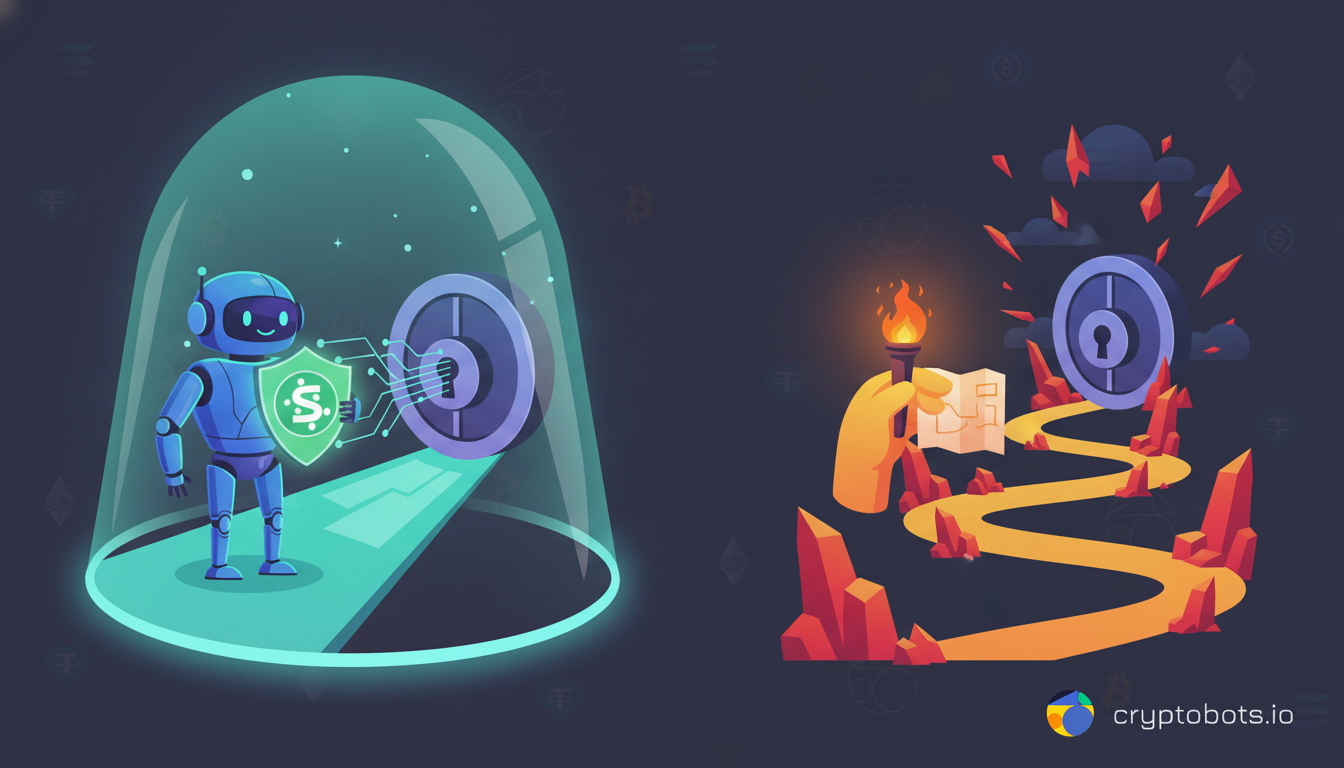
Automated software executes protective stop losses faster than any human can react and eliminates emotional hesitation during sudden market drops. Software cannot remove price volatility or market risk entirely, and a poorly built strategy can still lose money. However, using automated tools with non-custodial API permissions is generally safer than manual trading because the system enforces risk rules without panic or fatigue.
If you want to automate your execution while keeping complete control of your capital, you can get started with zero upfront cost. Non-custodial API keys keep your assets inside your own exchange account, and you pay only when the software generates net profits.
Solana volatility and market speed
Solana processes thousands of transactions per second with sub-second finality. This underlying architecture creates liquid order books across major spot and derivatives exchanges. For active traders, rapid execution provides constant price movement and tight spreads, but high transaction velocity also means market shifts happen fast.
When macroeconomic news, protocol updates, or market sentiment changes break, SOL prices can move several percentage points in seconds. Flash crashes and swift trend reversals can drain unmanaged positions before a trader even opens an exchange app. Navigating this environment requires instant risk parameters, whether orders are placed manually or through code.
Where manual Solana trading breaks down
Manual trading relies on personal chart analysis, intuition, and physical order entry. While manual control feels familiar, relying on human execution introduces emotional and physical constraints that expose capital to unnecessary risk.
Psychological friction causes the majority of manual trading losses. Fear pushes people to sell at the bottom of a crash, locking in permanent losses right before a rebound. Greed leads traders to hold winning positions past target resistance levels, watching open profits disappear. When a trade goes bad, panic selling or revenge trading often leads people to abandon their written stop-loss plans entirely.
Crypto markets operate continuously across time zones. A person cannot track order books around the clock. Missing a sudden market reversal while sleeping or working can lead to steep losses if defensive stop orders were not placed in advance.
Executing manual trades during high volatility also causes decision fatigue. Monitoring technical indicators, order book depth, and live news feeds simultaneously taxes human focus. Over time, fatigue results in misplaced stop losses, bad entries, and delayed exits.
Manual orders also suffer from network and human latency. By the time a trader spots a price move and clicks the buy or sell button, the exchange order book has already moved. This delay creates slippage, filling orders at worse prices and eating into long-term returns over time.
How automated Solana trading reduces risk
When evaluating if automated Solana trading is safer than manual execution, programmatic trading offers clear structural advantages for capital preservation.
Automated trading software monitors exchange order books and submits orders based on preset logic through exchange API keys. Secure setups restrict these API keys to trading permissions only, disabling withdrawal access so capital remains inside your exchange account.
The primary safety benefit of automation is strict rule enforcement. Algorithms execute orders according to programmed parameters without panic or greed. When the price touches a stop-loss or take-profit threshold, the order triggers immediately, preventing manual overrides that turn small losses into account-clearing drawdowns.
Trading software calculates technical indicators and routes orders in milliseconds. In fast markets, this speed minimizes slippage and fills orders near target prices. Bots also monitor positions continuously without experiencing tiredness or distraction.
Automated systems enforce risk rules directly inside the code. Hard percentage stop losses, trailing exits, and maximum drawdown limits trigger automatically. Platforms like CryptoBots.io use conservative leverage capped at 1.0x for inverse contracts and 1.5x for linear derivatives along with a 40% safety net buffer. This conservative approach prevents forced liquidations during sudden market dips.
Before risking live funds, traders can test automated algorithms against historical exchange data. Backtesting measures maximum historical drawdowns, win rates, and profit factors across different market cycles, helping uncover strategy flaws and refine risk parameters beforehand.
Common strategies automated bots run on Solana include:
- Trend following: buys during confirmed upward momentum and exits when momentum slows.
- Grid trading: places a series of buy and sell limit orders at regular price intervals to capture gains during sideways consolidation.
- Dollar-cost averaging (DCA): accumulates SOL at fixed time intervals, smoothing out entry prices across market cycles.
- Arbitrage: captures temporary price discrepancies for SOL across different exchange order books or trading pairs.
Technical risks and limitations of trading bots
While algorithmic execution removes emotional errors, it introduces technical risks that traders need to understand.
A trading bot follows its programmed instructions without context. Logic bugs, unhandled software edge cases, or incorrect parameter inputs can cause a bot to execute wrong orders or fail to trigger defensive exits. Software requires thorough testing before deployment.
Automated trading also relies on server uptime, API stability, and internet routing. If an exchange API becomes unresponsive during extreme market volatility, pending stop orders may fail to trigger on time, leaving open positions exposed.
Extreme market crashes or blockchain congestion can drain order book liquidity. Even fast bots need matching counterparty orders on the exchange to complete a trade. During severe market events, low liquidity can still result in slippage. Keeping leverage low helps insulate portfolios from these systemic events.
Backtesting carries the risk of curve fitting, where an algorithm is over-optimized to match past price charts. A strategy over-tuned to historic data often fails in live markets when price behavior changes. Testing strategies across multiple market regimes helps build realistic expectations.
Evaluating platform security and capital protection
The safety of an automated trading strategy depends heavily on the security standards of the platform hosting it.
Fund security should be the top priority. Legitimate platforms operate exclusively through non-custodial API keys with withdrawal permissions disabled. Never transfer funds directly to a third-party bot provider. Keeping your assets inside established exchanges ensures you retain full wallet custody at all times.
Transparent performance tracking is equally critical. Look for providers that offer public order histories and real-time dashboards. Verified records let you inspect drawdown history and win rates without relying on marketing claims. You can inspect live setup performance on the CryptoBots.io proof of performance page or analyze algorithmic parameters through the strategy explorer.
Risk settings must be fully customizable. A safe platform allows you to configure position sizes, leverage caps, and stop-loss levels to match your individual risk tolerance. Dedicated Solana bots use algorithms tuned specifically for SOL volatility patterns and liquidity depth.
CryptoBots.io aligns its business model with trader success through a performance-based structure. There are no setup fees or recurring monthly fees. Instead, the platform charges a 33% profit share only on net realized profits generated by the software. If the bot does not generate net gains, you pay nothing. Combined with a leverage cap of 1.0x for inverse contracts and 1.5x for linear derivatives and non-custodial API setup, this framework focuses on capital preservation above all else.
Frequently asked questions
Is automated Solana trading risk-free?
No. Automated trading eliminates emotional mistakes and speeds up execution, but market risk always exists. Bots can lose money during prolonged market declines, exchange API outages, or unexpected liquidity shocks. Total risk depends on your strategy configuration, leverage, and stop-loss settings.
How do trading bots handle sudden Solana price drops?
Trading software triggers pre-programmed stop-loss orders automatically when the price drops below your set threshold. The bot closes the position immediately to limit losses, acting without human delay or emotional hesitation.
Can I adjust the risk settings on my Solana trading bot?
Yes. Reputable platforms let you customize position limits, stop-loss percentages, and overall leverage settings. CryptoBots.io uses conservative defaults, including leverage capped at 1.0x for inverse contracts and 1.5x for linear derivatives and a 40% safety buffer.
Do I need to transfer my Solana to a bot platform?
No. Secure platforms use API keys with withdrawal permissions turned off. Your SOL remains safely inside your existing exchange wallet while the bot only sends buy and sell orders.
What starting capital is required to trade SOL automatically?
Minimum capital depends on your exchange’s minimum order size rules. Because CryptoBots.io operates with zero upfront fees and charges only on realized profits, you only need enough capital in your exchange account to satisfy exchange order minimums.
Conclusion
Determining if automated Solana trading is safer than manual execution comes down to discipline and system speed. Manual trading leaves your portfolio exposed to panic, hesitation, and physical exhaustion during sharp price shifts. Automated software eliminates these human errors by executing protective risk rules instantly and monitoring markets non-stop.
Although algorithms cannot eliminate market volatility or technical risks, using a non-custodial, API-only platform with low leverage provides a much safer framework for trading SOL. By keeping capital in your own exchange account and enforcing strict stop losses, you can trade Solana with greater consistency and controlled downside risk.
Ready to automate your SOL trades while keeping full custody of your capital? Visit CryptoBots.io today to connect your exchange API and start trading with zero upfront fees.